

Janjgir-Champa, Chhattisgarh | Health News
Sometimes a decision does not create immediate noise, but it quietly reflects deeper concerns within a system. A recent administrative move in the Janjgir-Champa district health department has triggered similar questions about transparency, propriety, and governance.
Dr. Anita Shrivastava, who assumed charge as the In-Charge Chief Medical and Health Officer (CMHO) of Janjgir-Champa on January 5, 2026, issued orders within just 15 days assigning her husband, Dr. Manish Shrivastava, two key and sensitive responsibilities in the district.
According to official orders, Dr. Manish Shrivastava has been appointed In-Charge District Malaria Officer and Store/Inventory Officer, and has been attached to the district health office. Both roles are directly linked to public health management, procurement, and resource allocation.
Fifteen Days, Two Key Assignments, Multiple Concerns
The malaria control program and medical inventory management involve significant public funds and affect essential healthcare delivery. The decision to assign both responsibilities to the CMHO’s spouse has led to discussions within departmental circles, with officials and observers raising concerns about conflict of interest and administrative ethics.
Previous Complaints Add to the Debate
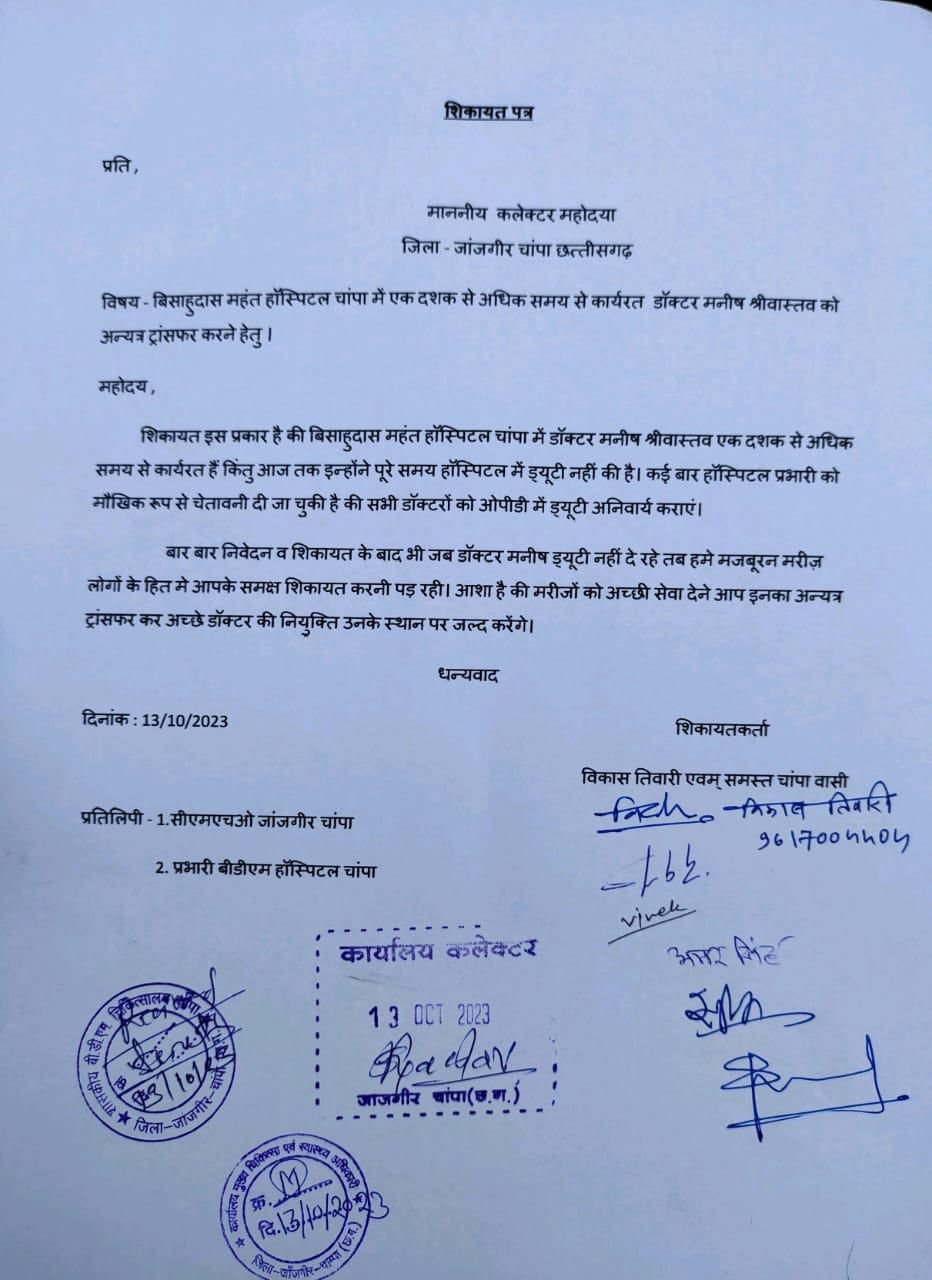
Dr. Manish Shrivastava was previously posted at BDM Hospital, Champa, where local citizens had reportedly submitted written complaints to the District Collector. The complaints alleged that he was frequently absent from the Outpatient Department (OPD), causing long waiting times for patients and disruptions in treatment.
Residents claimed that repeated absenteeism had affected public trust in government healthcare services. However, no information regarding any formal inquiry, findings, or disciplinary action related to these complaints has been made public so far.
Lack of Transparency Following Complaints
Despite demands from complainants for corrective action or transfer, there has been no publicly available investigation report, official conclusion, or clarification from authorities.
- No inquiry report released
- No official findings shared
- No public response issued
This absence of transparency has further fueled speculation and concern.
Who Is Really Running the Department?
Sources within the department suggest that the health administration is currently functioning in a manner similar to informal governance models seen elsewhere, where official authority rests with one individual while operational influence is exercised by another.
While Dr. Anita Shrivastava formally holds the CMHO position, insiders claim that Dr. Manish Shrivastava is perceived to have significant influence over key administrative and operational decisions. Comparisons are being drawn to the well-known phenomenon of “proxy leadership,” where unofficial authority overshadows formal roles.
Impact on Claims of Women’s Empowerment
The situation has also sparked debate over broader claims of women’s empowerment in public administration. While governments emphasize leadership and decision-making roles for women, perceptions of external influence over a woman officer’s authority risk undermining both administrative neutrality and the spirit of empowerment.
Nodal Appointment Despite Past Allegations
Dr. Manish Shrivastava’s appointment as nodal officer for the malaria control program and district medical stores was approved by the District Collector. However, experts question whether all relevant facts, including earlier complaints, were fully disclosed during the approval process.
Key questions remain unanswered:
- Were all previous allegations formally placed before the approving authority?
- Was the approval granted with complete information?
- Does the process meet standards of transparency and accountability?
Silence Raises More Questions
So far, no official statement, departmental clarification, or administrative review has been announced at any level. Governance experts note that when systems fail to provide answers, public scrutiny becomes inevitable.
As the matter continues to draw attention, observers stress that transparency and accountability are essential—not only to protect institutional integrity, but also to maintain public trust in healthcare administration.