

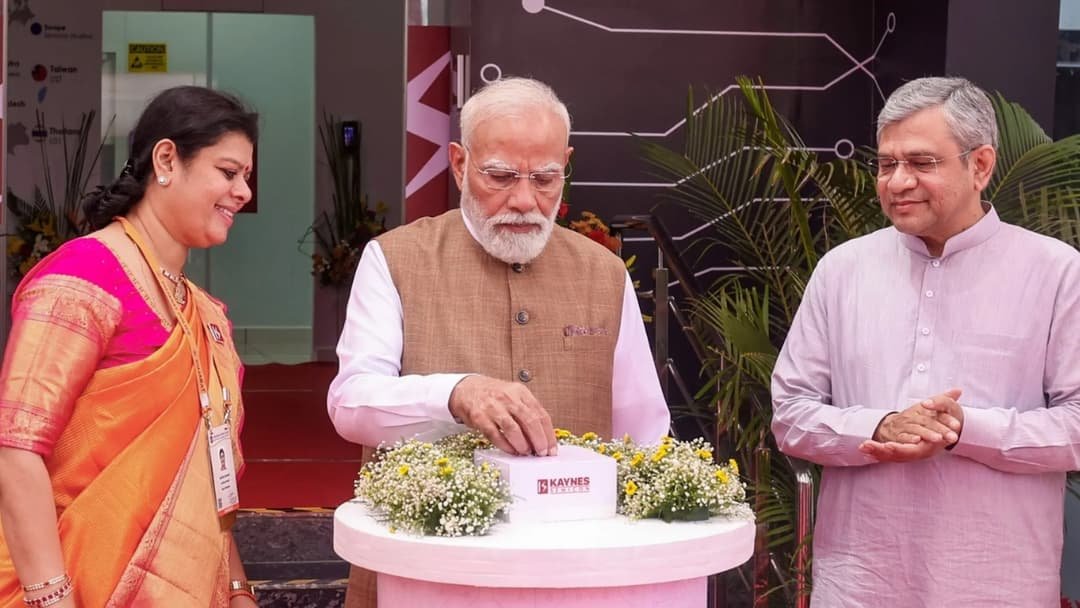
Sanand, India — : Narendra Modi on Wednesday inaugurated a new semiconductor manufacturing facility operated by Kaynes Technology in Sanand, marking a significant milestone in India’s push to become a global hub for semiconductor production.
The inauguration officially signals the start of production at the plant and underscores India’s accelerating efforts to build a self-reliant and resilient semiconductor ecosystem amid rising global demand for chips.
A Strategic Leap Toward Self-Reliance
Speaking at the event, the Prime Minister described the facility as a “landmark step” in India’s semiconductor journey. He emphasized that the entry of an Indian company into semiconductor manufacturing represents a strong foundation for the country’s integration into global chip supply chains.
The development follows closely on the heels of another major milestone in Sanand—the recent launch of production at Micron Technology’s facility—highlighting the rapid pace of growth in India’s semiconductor sector.
Modi congratulated the leadership of Kaynes Technology, the Gujarat state government, and the workforce for successfully executing the project, noting that such collaborations are key to building a globally competitive semiconductor industry.
Bridging India and Global Technology Hubs
The Sanand plant will manufacture advanced Intelligent Power Modules (IPMs), which are critical components used in electric vehicles (EVs), industrial automation systems, and next-generation electronics.
Many of these products have already been booked for export to international partners, including companies based in California. The Prime Minister described this development as creating a “bridge between Sanand and Silicon Valley,” reinforcing India’s broader vision of “Make in India, Make for the World.”
India Semiconductor Mission Gains Momentum
The inauguration also highlights the progress of the India Semiconductor Mission, launched in 2021 to strengthen the country’s semiconductor capabilities.
Key highlights of the mission include:
- Over 10 semiconductor projects currently underway across six Indian states, with a combined investment exceeding ₹1.6 lakh crore (approximately $19 billion USD)
- Development of the indigenous Dhruv 64 microprocessor
- Expansion into semiconductor equipment and materials under Semiconductor Mission 2.0
- Training of more than 85,000 design professionals
- Support for nearly 400 universities and startups through the Chips-to-Startup program
India’s semiconductor market, currently valued at around $50 billion, is projected to surpass $100 billion by the end of the decade, reflecting strong domestic demand and export potential.
Securing Supply Chains and Critical Resources
Addressing global supply chain vulnerabilities, the Prime Minister emphasized the need for secure access to critical raw materials such as rare earth elements. He highlighted initiatives like the National Critical Minerals Mission and the development of a Rare Earth Corridor across India’s coastal states.
These measures aim to reduce dependency on limited global suppliers and ensure long-term technological and economic security.
India’s “Techade” Vision
Framing the current decade as India’s “Techade,” Modi stated that the country is not only adapting to global technological transformation but actively shaping it. With rapid advancements in artificial intelligence, fintech, quantum computing, and digital infrastructure, the semiconductor sector is expected to play a central role in India’s growth trajectory.
The launch of the Kaynes semiconductor plant in Sanand marks another decisive step in positioning India as a key player in the global electronics and semiconductor manufacturing landscape—strengthening its ambition to emerge as a trusted and competitive technology powerhouse.