

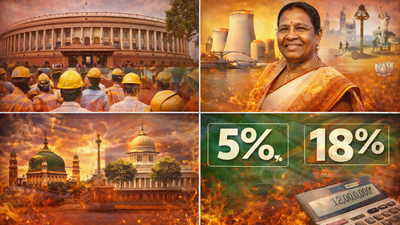
New Delhi: Despite repeated disruptions during parliamentary sessions, especially in the monsoon session, India’s Parliament passed several significant and often controversial legislations in 2025. These laws span critical sectors such as employment, energy, sports, labour, taxation, digital governance, and minority affairs, and are expected to have a long-term impact on the country’s economy and governance framework.
VB-G RAM G Bill Approved
During the Winter Session, Parliament approved the Viksit Bharat Guarantee for Employment and Livelihood Mission (Rural) – VB-G RAM G Bill, which restructures the existing MGNREGA scheme.
Under the new law:
- Guaranteed employment days have been increased from 100 to 125 days per year
- The scheme will no longer be purely demand-driven
- Expenditure will be capped by the Centre, with states sharing part of the cost
The move aims to balance rural employment security with fiscal discipline.
SHANTI Bill 2025 Passed
Parliament also cleared the SHANTI (Sustainable Holistic Atomic Nuclear Transition Initiative) Bill, 2025, replacing outdated nuclear energy laws.
Key objectives include:
- Increasing the share of nuclear energy in India’s energy mix
- Allowing private sector participation
- Encouraging innovation in nuclear technology
The law also grants statutory status to the Atomic Energy Regulatory Board, strengthening oversight.
National Sports Governance Reform
The National Sports Administration Act, 2025 received presidential assent from President Droupadi Murmu. The legislation seeks to:
- Improve governance and transparency in sports bodies
- Ensure athlete welfare
- Promote overall sports development
It is expected to bring structural reforms to India’s sports ecosystem.
Online Gaming Regulation Act, 2025
To address growing concerns around addiction and financial risks, Parliament passed the Online Gaming Promotion and Regulation Act, 2025.
The law focuses on:
- Regulating online money games
- Preventing gambling-related addiction and fraud
- Promoting responsible and safe gaming practices
Four Labour Codes to Take Effect
In a major labour reform push, the government announced that all four Labour Codes will come into force from 21 November 2025. These include:
- Code on Wages
- Industrial Relations Code
- Social Security Code
- Occupational Safety, Health and Working Conditions Code
The reform consolidates 29 old labour laws into a streamlined framework aimed at improving worker welfare and ease of doing business.
Waqf (Amendment) Act, 2025
Passed in April, the Waqf (Amendment) Act, 2025 aims to enhance:
- Transparency in the management of Waqf properties
- Participation of diverse Muslim communities
- Social welfare outcomes
However, the law faced opposition from several Muslim organizations and opposition parties.
Tax and GST Reforms
Further reforms were approved through the 56th GST Council meeting, paving the way for next-generation GST restructuring. Key proposals include:
- Simplification of tax rates
- Possible move towards a two-slab structure (5% and 18%)
On the direct tax front, the Income Tax Act, 2025 received presidential assent in August, replacing the Income Tax Act of 1961.
- No new taxes have been introduced
- Legal language has been simplified
- Annual income up to ₹12 lakh has been made tax-free, offering major relief to the middle class
- The law will take effect from 1 April 2026
A Transformative Year for Legislation
Overall, 2025 proved to be a landmark year for legislatives legislation, with Parliament passing reforms that could significantly shape India’s economic growth, governance systems, and everyday lives of citizens in the years ahead.