

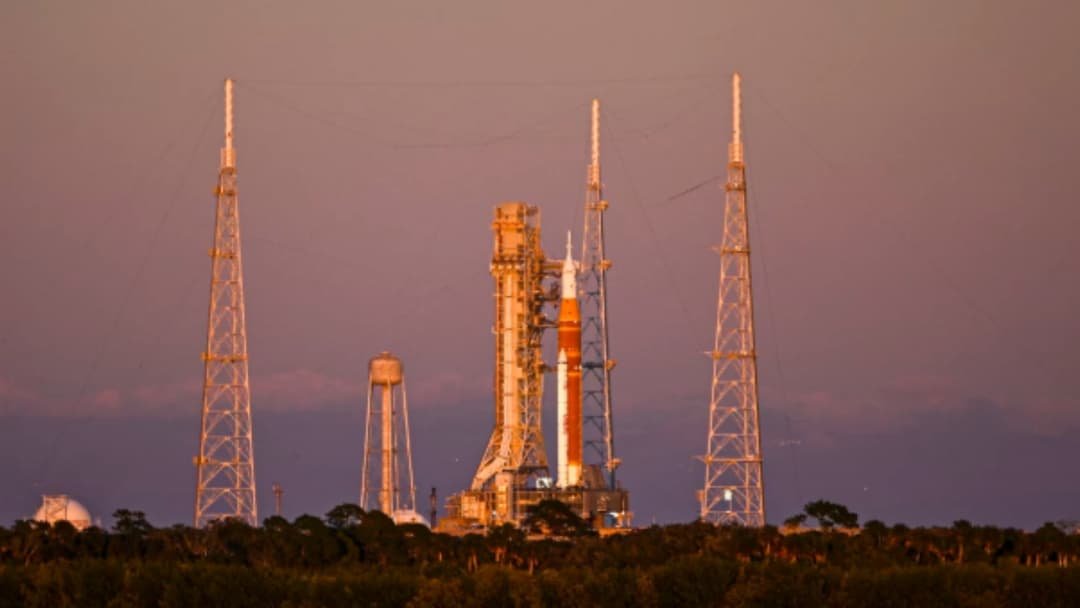
Washington, D.C.: NASA’s plan to send astronauts back to the Moon has encountered a major technical setback, raising fresh uncertainty over the agency’s 2026 lunar launch timeline. The Artemis II mission, intended to carry humans to lunar orbit for the first time in more than five decades, has been delayed following the discovery of a persistent hydrogen fuel leak in the agency’s Space Launch System (SLS) rocket.
Technical Issue at Kennedy Space Center
The problem was identified during a recent wet dress rehearsal at NASA’s Kennedy Space Center, a critical pre-launch test in which the rocket is loaded with super-cooled liquid hydrogen and liquid oxygen. Sensors detected a leak at the core stage umbilical connection, an area that transfers fuel from ground systems into the rocket.
NASA engineers attempted multiple remote resealing procedures, but the hydrogen leak persisted. As a result, officials were forced to halt testing and reassess the launch schedule.
Crew Safety Drives the Decision
Unlike Artemis I, which flew without astronauts, Artemis II will carry a four-member crew: Reid Wiseman, Victor Glover, Christina Koch, and Jeremy Hansen. With human lives at stake, NASA emphasized that safety remains non-negotiable.
“We do not fly until it is safe,” NASA Administrator Bill Nelson said in a statement, underscoring the agency’s zero-tolerance policy for unresolved technical risks. Hydrogen leaks have been a recurring challenge for the SLS program, but officials stressed that even minor anomalies must be fully resolved before crewed flight.
Revised Launch Outlook
NASA is now preparing to roll the SLS rocket back to the Vehicle Assembly Building (VAB), where engineers will replace the faulty seals and conduct additional inspections. As a result, the Artemis II launch—originally targeted for early 2026—is now expected to shift to late Q2 of 2026, pending successful repairs and follow-up testing.
The delay also raises concerns about the broader Artemis program timeline, including Artemis III, the mission aimed at landing the first woman and the first person of color on the lunar surface.
Broader Implications
While NASA maintains confidence in the long-term goals of the Artemis program, the latest setback highlights the technical complexity of returning humans to deep space. Industry analysts note that resolving the hydrogen leak is essential not only for Artemis II, but for restoring confidence in the SLS rocket as the backbone of America’s lunar ambitions.
For now, NASA officials say the focus remains firmly on engineering fixes and crew safety—even if it means waiting longer to return to the Moon.