

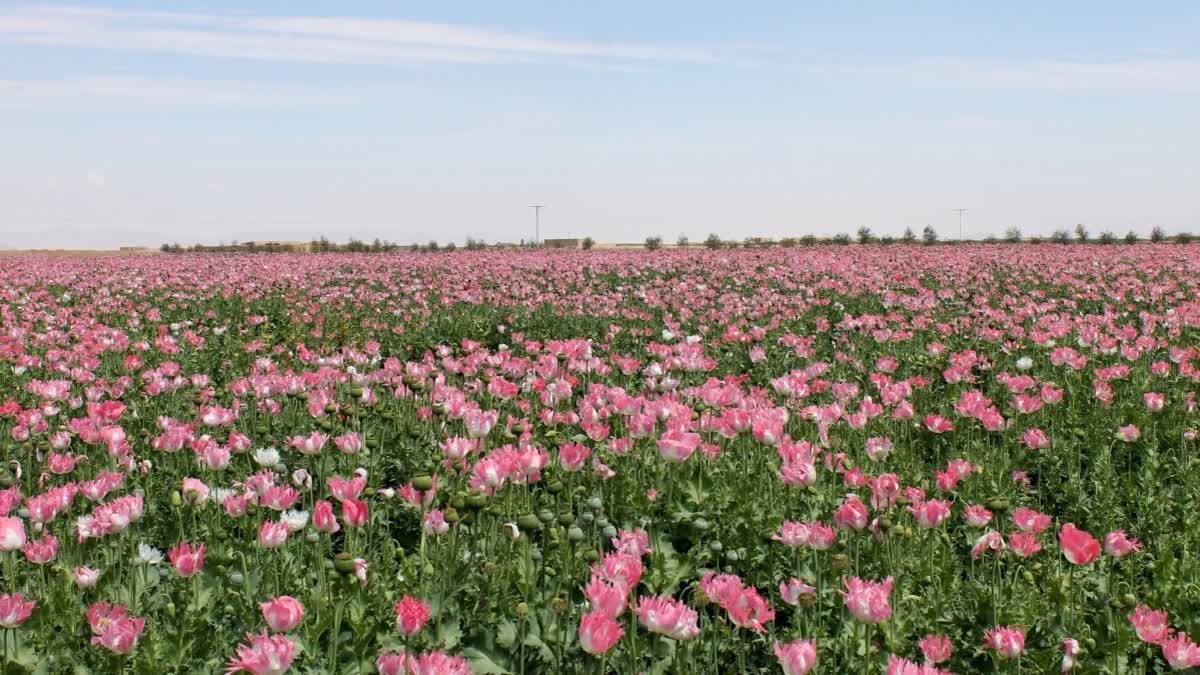
New Delhi: The Meitei Alliance, a coalition of Meitei diaspora organizations, has appealed to Prime Minister Narendra Modi to declare illegal poppy cultivation in Manipur a matter of national security and an environmental emergency, citing its deep links to drug trafficking, organized crime, and the prolonged crisis in the state.
In a memorandum submitted to the Prime Minister’s Office (PMO) on Monday, the alliance called for stronger management of the India–Myanmar border under the constitutional and legal authority of the Union government. Copies of the memorandum were also sent to Union Home Minister Amit Shah and Manipur Chief Minister Yumnam Khemchand Singh.
According to the memorandum, the unchecked expansion of illegal poppy cultivation in Manipur’s hill districts and the steady flow of narcotics across the international border have emerged as one of the primary drivers of violence, displacement, and governance breakdown in the state.
“Manipur has endured years of internal conflict marked by large-scale loss of life, mass displacement, destruction of livelihoods, and erosion of constitutional governance,” the alliance stated. “A major root cause of this crisis is the unrestrained growth of illegal poppy cultivation and cross-border drug trafficking, which has given rise to a powerful narco-economy fueling divisive ethnic politics.”
The Meitei Alliance demanded the creation of a unified central task force comprising security forces, intelligence agencies, forest officials, and revenue authorities to ensure the time-bound eradication of illegal poppy plantations. It also urged the central government to review—and, where proven—withdraw Suspension of Operations (SoO) agreements with militant groups allegedly involved in narcotics trafficking.
Official data released by the Manipur Police Department shows that between November 2, 2025, and February 8, 2026, authorities destroyed 2,618 acres of illegal poppy cultivation across districts including Kangpokpi, Ukhrul, Churachandpur, Senapati, Chandel, Kamjong, Tengnoupal, and Tamenglong.
The alliance argued that the scale, geographic spread, and persistence of these plantations point to the existence of highly organized and coordinated criminal networks. “Such large-scale cultivation cannot be described as subsistence farming,” the memorandum said. “It clearly represents industrial-level narcotics production in direct violation of Indian law.”
Based on official estimates, raw opium yield in Manipur averages around 25 kilograms per acre. This suggests that approximately 65,450 kilograms of raw opium were destroyed during the three-month operation.
The memorandum cited reports indicating that in 2025, raw opium in Myanmar was valued at around USD 365 per kilogram. By that estimate, the destroyed crop would be worth approximately USD 23.9 million (about ₹217.4 crore), with international market values potentially rising to nearly ten times that amount.
Despite repeated eradication drives and heavy security deployment, the alliance warned that illegal poppy cultivation has resurfaced on a large scale. This recurring pattern, it said, underscores a troubling reality: poppy cultivation in Manipur is not an isolated criminal activity, but a resilient and well-entrenched narco-economy capable of regenerating unless its support networks are dismantled entirely.
The Meitei Alliance concluded by urging the central government to treat the issue not merely as a law-and-order challenge, but as a strategic threat to national security, environmental stability, and constitutional governance in India’s northeastern frontier.