
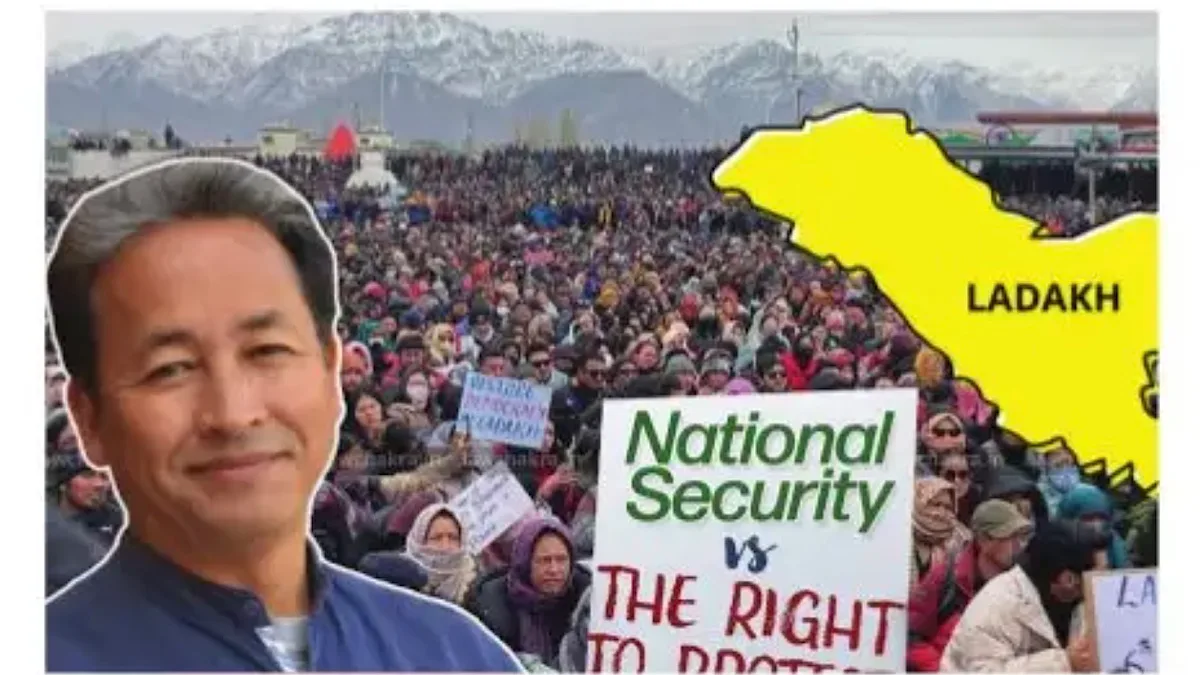
Violence erupted in Ladakh on 24 September as some who were involved in the Sonam Wangchuk-led hunger strike were shifted to hospital.
The arrest of Sonam Wangchuk brings to an end the sordid drama of violence in Ladakh. Violence erupted in Ladakh on 24 September as some who were involved in the Sonam Wangchuk-led hunger strike were shifted to hospital. Wangchuk, the face behind the upsurge, termed the violence as ‘Gen Z’ protests, linking them to recent incidents in Nepal which overthrew the Oli government. Soman had earlier threatened to initiate the Arab Spring in Ladakh. The protests, the most violent in 70 years, left four dead and 90 injured. A couple of months ago, Wangchuk released a video encouraging self-immolation. He even sought likely venues for self-immolation, suggesting the Home Minister’s residence, Parliament and the UN office in Delhi as possible options.
Burning of the Leh office of the BJP alongside other government institutions was Sonam’s message of his power to initiate violence at will. Protests in Ladakh increased post his visit to Pakistan for a climate conference in February this year. The possibility of a foreign link behind the agitation needs investigation. The current violence was appropriately timed. First, it impacts ongoing dialogue between the government and two major Ladakhi organizations, the Leh Apex Body and Kargil Democratic Alliance. The next round of official talks is scheduled for 6 October and informal ones were to have been on 25 September, but were postponed. A resolution was on the cards, but a solution satisfying the majority could damage Sonam’s control. The talks had already given results. Reservations for Ladakh scheduled tribes has increased to 84 per cent from 45 per cent. One-third reservations for women in councils has been accepted. With these agreements, recruitments for 1,800 posts had commenced.
Other subjects would also be handled. Secondly, the UN General Assembly was in session. It would have opened doors for protests to be raised globally and for India to be criticized. Thirdly, this was a display of Wangchuk’s power. His earlier three-day protests at the same venue concluded with little support, compelling the organizers to enforce a bandh on the last day to display participation. Similarity with Anna Hazare’s 2011 protests was evident. In 2011, Hazare launched his campaign for a Lok Pal bill and it was his hunger strike which compelled the government to back down.
Alongside Anna was Kejriwal who moved on to form AAP which ruled Delhi for two terms before being mired with corruption. Does Sonam have similar political ambitions? Hazare’s protests were backed by the BJP as it had made the then Manmohan Singh government uncomfortable. In this case, violence and protests are backed by the Congress and National Conference leaders Farooq and Omar Abdullah alongside opposition politicians as it makes the BJP government at the Centre uncomfortable. Fourthly, allotment of government land to Wangchuk for establishing a university was cancelled due to irregularities, which he has objected to. Wangchuk’s hunger strike demanding statehood and the sixth schedule has pushed investigation into irregularities which led to the cancellation of land to his Himalayan Institute of Alternatives, Ladakh, on the backburner.
Fifthly, violent protests are never spontaneous. Protests in Bangladesh were orchestrated and funded by inimical elements. Gen Z protests in Nepal followed carefully crafted anger against the political class after months of pushing the #NepoBaby hashtag on social media. Ultimately a spark was needed to ignite fire. In Ladakh the instigation was provocative speeches by Wangchuk and the spark was hospitalisation of two senior members of the hunger strike team. Sixthly, protests and violence need to be funded. J and K is a perfect example of how protests were funded by flow of hawala funds to the Hurriyat. Hurriyat held the state hostage. Bandhs were called at will, violence to help terrorists escape was orchestrated. Stone pelting had become a cottage industry.
As soon as hawala stopped, so did the protests. The farmers’ agitation and Shaheen bagh are other examples of foreign funding of protests. Wangchuk also displayed he has power to start and stop protests, holding the administration to ransom. The question remains whether protests in Ladakh, a normally peaceful region, were funded by inimical NGOs as in other cases. Investigations into illegal foreign funding into Wangchuk’s organisations are ongoing. Many of Wangchuk’s colleagues had already called off their hunger strikes, indicating an acceptance of ongoing talks, but he persisted. As soon as the violence began, having achieved his aim and sent his message, he left for his village.
He conveyed to the government that he is now the new power broker in Ladakh and should be consulted at every stage. Is this a copy of the Gorkhaland agitation? In 1986 Subhas Ghising led Gorkhaland protests held the Darjeeling region to ransom, leaving 1,200 dead and the valley shut for over 200 days. The result was creation of the Darjeeling Hill Council controlled by Ghising. He eliminated all his opponents and ruled the region with a firm hand. He was known as ‘Pahar ka Raja.’ Ghising was ultimately banished from Darjeeling and died a political non-entity in 2015. Is Wangchuk looking to become ‘Ladakh ka Raja.’ Under erstwhile J and K there was hardly any development in Ladakh, yet there were no protests. Wangchuk has himself mentioned “People in Ladakh say they can see a difference in terms of development, roads have been built.”
At the same time, he mentions that people cannot be happy ‘only with development.’ He has compared Ladakh to Tibet, claiming that even Tibet has witnessed development but unhappiness persists. If there were no protests for 70 years, despite no development, the question is why now when development is ongoing and when tensions with Pakistan and China remain high. It was Ladakh which was demanding a UT status, why has the demand changed now? Who is behind it? In every case of violence and protest in India, whether it be J and K, Anna Hazare or even Gorkhaland, it was youth who were exploited for political gains by a few.
Wangchuk is aware that Ladakh being a sensitive region is a matter of special concern to the government. His intent is total control where the government has to seek his support and he is termed ‘Ladakh ka Raja.’ This is why the government is continuing talks with a broader base of interlocutors rather than just Wangchuk, which reduces his power. Wangchuk will be granted bail but his arrest alongside talks with key groups sends a message of firmness of government intent. It cannot let individuals become demigods in sensitive regions.
(The writer is a retired Major-General of the Indian Army.)