

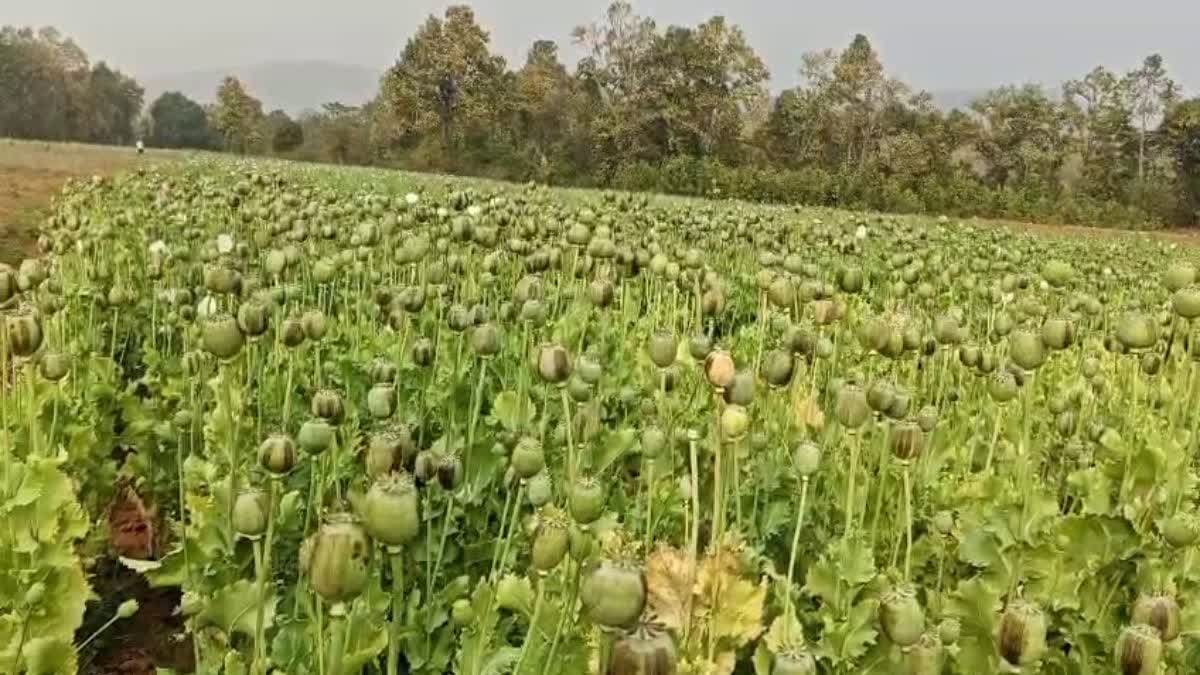
Balrampur, Chhattisgarh: A second major case of illegal opium cultivation has surfaced in the Indian state of Chhattisgarh, this time in Balrampur district, intensifying the ongoing political and law enforcement scrutiny surrounding the issue.
The latest development comes days after authorities exposed large-scale opium farming in Samoda village under the Jevra Sirsa outpost in Durg district on March 6. In that case, police and narcotics officials discovered opium poppy plants hidden within a maize field spread across more than five acres.
Now, a similar case has been reported from Tripuri village in the Kusmi police station area of Balrampur district. According to officials, approximately three acres of farmland were allegedly being used for illegal opium cultivation.
Additional Superintendent of Police Vishwadeep Tripathi confirmed that police and revenue department teams rushed to the spot after receiving information about the cultivation. Authorities are currently conducting a detailed investigation and taking action in accordance with the law.
Preliminary findings suggest that the land used in Balrampur was taken on lease by the accused. Two individuals, identified as Rupdev and Kaunsheel, both residents of Jharkhand, are suspected to be involved. Officials say the land was reportedly leased around the Diwali festival, after which the illegal crop was planted.
Meanwhile, in the earlier Durg case, police have arrested three individuals: Vinayak Tamrakar, Golu Thakur, and Vikas Vishnoi. Tamrakar, a local political figure associated with the Bharatiya Janata Party (BJP), was suspended by the party following the revelations.
Authorities are also searching for Achala Ram Jat, a resident of Jodhpur in Rajasthan, who is believed to be the main planner behind the operation.
The back-to-back revelations have sparked a political storm in Chhattisgarh, with the issue being debated both on the streets and in the state assembly as investigations continue.