

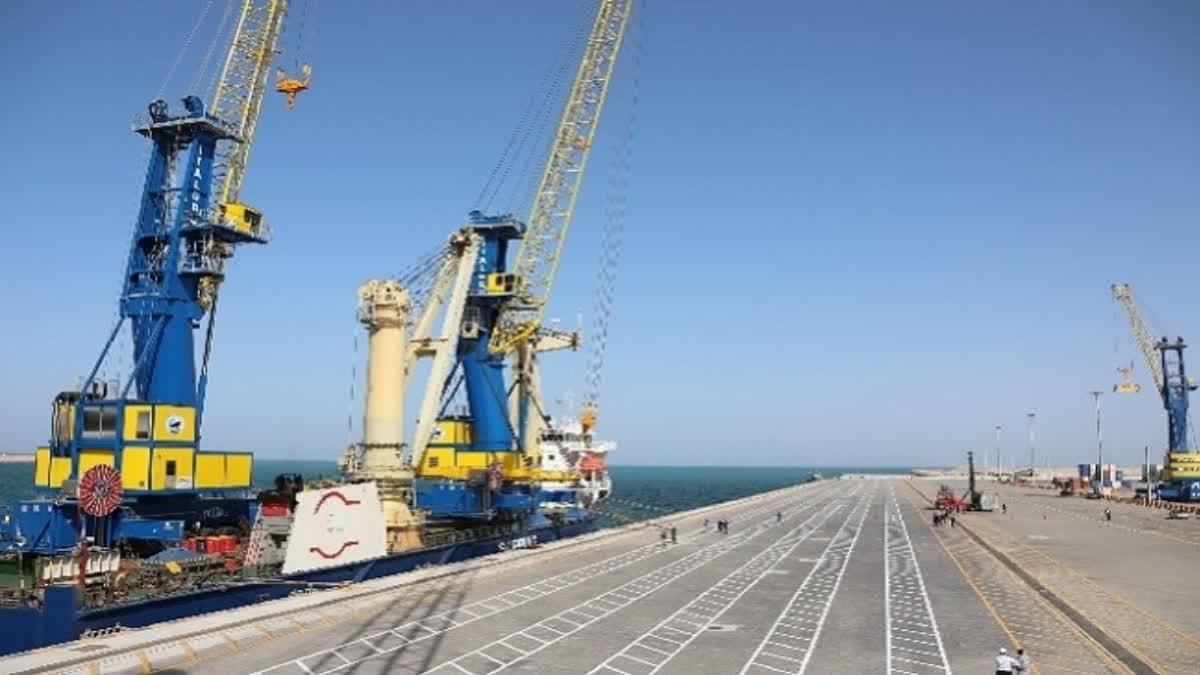
New Delhi: India appears to be quietly stepping back from the strategic Chabahar Port project in Iran, signaling a cautious recalibration of its foreign policy amid escalating tensions between the United States and Iran. The move has sparked debate over whether New Delhi is choosing a “middle path” to protect its broader geopolitical and economic interests under mounting American pressure.
On February 1, the Indian government made its position clear—albeit indirectly—by excluding any financial allocation for the operation, maintenance, or management of Chabahar Port in the Union Budget for 2026–27. The absence of funding has been widely interpreted as confirmation that India will no longer manage the port, marking a significant shift in a project once hailed as India’s most important overseas strategic investment.
Why Chabahar Mattered to India
Located on Iran’s Makran coast along the Gulf of Oman, Chabahar Port has long been central to India’s regional strategy. It offered New Delhi a direct maritime route to Afghanistan and Central Asia while bypassing Pakistan—an advantage of immense strategic value. The port was also envisioned as a gateway for expanding India’s trade footprint in Central Asia and strengthening its role in regional connectivity initiatives.
Despite its importance, the Indian government has remained strategically silent on whether it has formally relinquished control of the project. Iranian officials, too, have stated that they have received no official communication from New Delhi regarding a withdrawal. Even Tehran Times, Iran’s government-linked national daily, has refrained from openly addressing the issue, suggesting diplomatic sensitivities on both sides.
U.S. Pressure and Strategic Compulsions
Analysts largely attribute India’s retreat to pressure from Washington. The United States has consistently opposed engagement with Iran, particularly as tensions escalated over Tehran’s nuclear program and regional activities. With U.S. naval deployments increasing near the Strait of Hormuz and Washington warning of possible military action, America has threatened sanctions against countries maintaining trade or strategic cooperation with Iran.
Crucially, the U.S. revoked the sanctions waiver that previously allowed India to operate Chabahar Port. While New Delhi did not publicly object, it requested time until April 2026 to wind down its operations. This came at a moment when India was already under economic strain from a 50 percent U.S. tariff imposed over its continued purchases of Russian oil.
Faced with the prospect of additional penalties for engaging with Iran, India appears to have chosen caution over confrontation.
A Window for Re-engagement?
The geopolitical environment, however, may be shifting. The U.S. has since rolled back the 50 percent tariff, and President Donald Trump is expected to renegotiate a broader trade agreement with India by the end of March. There is even speculation that Trump could visit India to finalize the deal.
This has raised a key question in diplomatic circles: if Washington deepens economic engagement with India, could it reconsider New Delhi’s request to restore the earlier Chabahar arrangement? Much will depend on whether U.S.–Iran tensions ease before India–U.S. talks move into the strategic domain.
A Project That Always Moved Slowly
Since the 2016 trilateral agreement between India, Iran, and Afghanistan, progress on Chabahar has been uneven. At the time, the U.S. had a significant military presence in Afghanistan and was keen to reduce dependence on Pakistan’s Karachi port for supply routes. Chabahar offered a viable alternative, aligning U.S. and Indian interests temporarily.
Yet India’s execution was often criticized as hesitant. The Indian firm managing the port, India Ports Global Limited, reportedly faced repeated funding constraints, at times requiring Russian financial support. While India claims to have invested over $250 million, Iran had expected far more—particularly for a railway line linking Chabahar to Afghanistan. When India withdrew from that commitment, Iran completed the project on its own.
Iranian officials periodically hinted that the port could be handed over to China, which already operates Pakistan’s nearby Gwadar Port. However, observers note that Tehran was never seriously inclined toward Beijing for Chabahar, preferring India for strategic and historical reasons.
Why Iran Preferred India
Chabahar lies just 70 kilometers from Gwadar, but the contrast is stark. Gwadar is a militarized port under China–Pakistan control, while Chabahar has remained a civilian port. Iran has traditionally viewed India as a stabilizing partner—one capable of balancing relations with the U.S., Russia, and China.
Local ties also matter. Many residents in Chabahar speak Hindustani, and Iran has long tolerated India’s quiet security interests in monitoring regional developments, including in Pakistan. Tehran also saw India as a potential anchor for strengthening the International North–South Transport Corridor (INSTC), linking Russia, Iran, and South Asia.
What Comes Next
India’s apparent pause on Chabahar reflects not a loss of interest, but a tactical retreat shaped by geopolitical realities. As New Delhi negotiates a major trade deal with Washington, Chabahar remains a silent but significant factor in the background.
Whether India can reclaim its role at the port will depend on broader U.S.–Iran relations and how much strategic autonomy Washington is willing to grant its Indo-Pacific partner. For now, India seems to be walking a tightrope—choosing balance over boldness, and patience over provocation.