

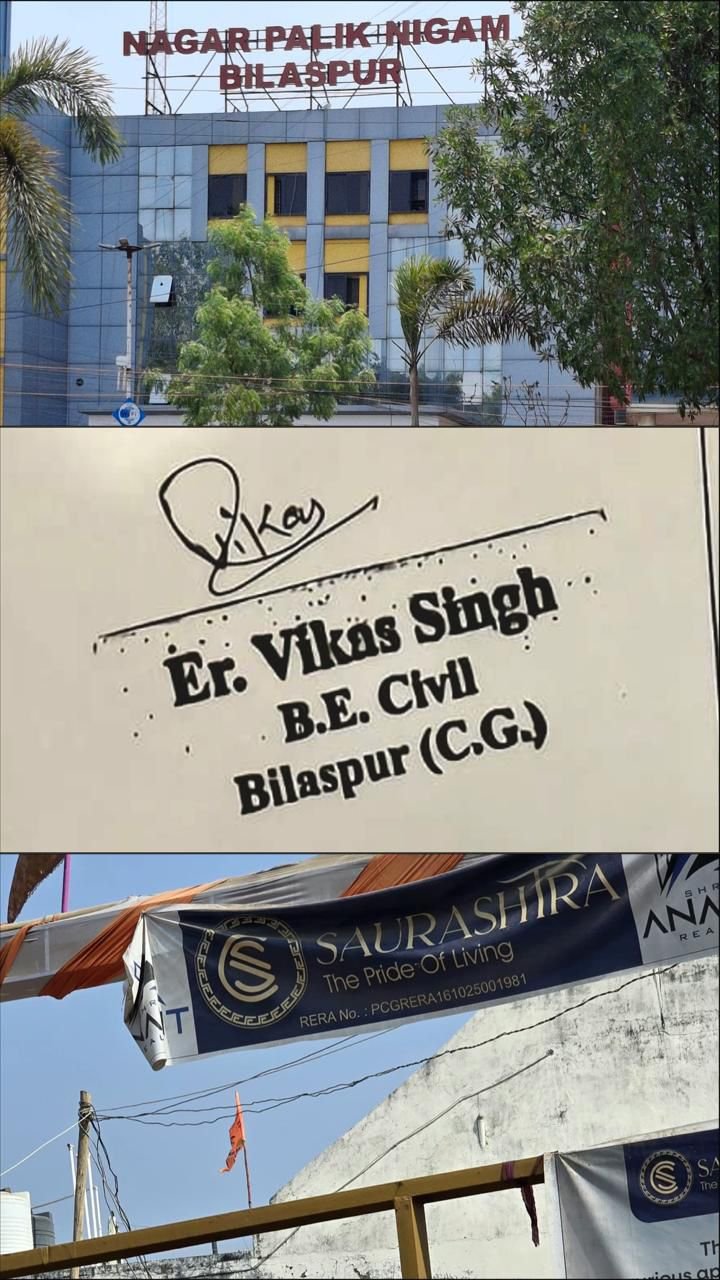
Bilaspur A major urban planning scandal has surfaced in Bilaspur, Chhattisgarh, raising serious questions about the functioning of the Municipal Corporation and the Town and Country Planning (TCP) Department. Documents related to a housing project suggest large-scale irregularities in the approval process, pointing to what may be a wider network of fraudulent building permissions and administrative collusion.
The controversy centers around a residential project proposed by M/s Anant Realty in the Agnya Nagar area. According to records, the project’s submitted area statement mentioned construction of 60 flats across four floors. However, when the department approved the building plan, the sanctioned design reportedly allowed 90 flats and six floors, creating a significant discrepancy between the original submission and the approved blueprint.
Urban planning experts say such a major difference between the area statement and the sanctioned plan is unlikely to be an ordinary clerical mistake. The scale of the variation suggests that the approval process may have been manipulated or bypassed.
Another startling revelation involves the architect listed on the project documents. The plans were reportedly prepared under the name “Vikas Singh.” However, investigations indicate that no registered architect or engineer with this name exists in Bilaspur. Records from the municipal corporation and professional bodies reportedly show no official registration linked to the name.
Authorities discovered that the same identity had allegedly been used earlier to secure approvals for multiple construction projects. The municipal corporation had previously suspended the license linked to this name after suspicions arose. Despite this, approvals for major projects continued to be issued using the same identity.
The issue gained further attention after a demolition drive carried out by the municipal corporation near the Old Bus Stand. The Mahua Hotel, which faced demolition over illegal construction on May 13, was also found to have had its building plan approved under the name “Vikas Singh.” Investigations revealed that the construction violated several approved conditions, including mandatory open space and parking provisions.
Following this discovery, the municipal corporation blacklisted the license associated with the name on July 24, 2025. When information was sought from the Indian Institute of Architects, the organization confirmed that no architect named Vikas Singh was registered in its records.
A deeper probe into departmental files revealed an even larger pattern. Officials reportedly found that more than 400 building plans and over 150 land layout approvals across the city had been cleared using the same identity. This suggests that approvals were issued for years under a name whose existence itself appears questionable.
The scandal also involves alleged violations of regulations concerning Economically Weaker Section (EWS) housing, which developers are required to provide in large residential projects. In this case, the builder submitted an affidavit claiming that EWS flats would be constructed on land located in Tifra village, Khasra number 407/7. However, revenue records reportedly show that the land mentioned in the affidavit is not registered in the builder’s name, raising allegations that authorities were misled through false documentation.
Investigators also found indications of unusually rapid approvals. In some instances, as many as 29 layout files were reportedly approved in a single day, an occurrence experts say is highly unlikely under normal administrative procedures. This has fueled suspicions that an organized network may have been operating within the system to expedite approvals.
The financial implications of the alleged irregularities could also be significant. Municipal estimates suggest that approval fees for residential layouts typically range from ₹75,000 to ₹250,000 per acre, while building plan approvals for individual houses usually cost ₹8,000 to ₹20,000. With hundreds of plans and layouts reportedly approved under questionable circumstances, experts believe the total financial transactions involved could amount to millions of rupees.
The revelations have shaken public confidence in Bilaspur’s urban planning system. Citizens and civic groups have expressed concern that if approvals can be issued on the basis of questionable documents, the legality and safety of many buildings in the city could also be in doubt.
Attention is now turning to whether an independent investigation will be launched. If the allegations are proven, there may be calls for criminal action against the developer Naman Goyal and officials allegedly involved in the approval process.
For now, the scandal has triggered intense discussion within Bilaspur’s real estate sector and administrative circles. Many observers believe the case may not be limited to a single project but could expose a much larger network of fraudulent approvals operating for years.