

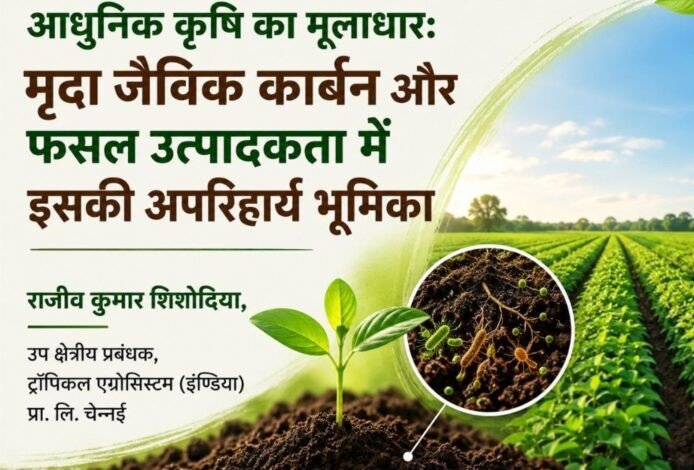

New Delhi | As concerns over declining soil health, excessive use of chemical fertilizers, and sustainable agricultural productivity continue to grow, agricultural experts are emphasizing the critical role of Soil Organic Carbon (SOC) in restoring soil fertility and ensuring long-term food security. In a detailed technical article, Rajeev Kumar Shishodia, Deputy Regional Manager, Tropical Agrosystem (India) Pvt. Ltd., explained the scientific significance of Soil Organic Carbon and highlighted modern approaches to improving soil quality.
According to the article, maintaining adequate Soil Organic Carbon (SOC) is becoming one of the most important challenges for modern agriculture, particularly as increasing food demand places greater pressure on agricultural land.
What is Soil Organic Carbon (SOC)?
Soil Organic Carbon (SOC) is the primary active component of Soil Organic Matter (SOM). Scientifically, approximately 58% of total soil organic matter consists of organic carbon.
SOC is not a single substance but a dynamic mixture formed from:
- Plant residues
- Crop root exudates
- Dead microorganisms
- Animal waste
- Organic compounds produced during microbial decomposition
According to soil scientists, SOC serves as the foundation that connects the physical, chemical, and biological properties of soil, making it a living ecosystem rather than an inert growing medium.
Three Major Components of Soil Organic Carbon
The article classifies Soil Organic Carbon into three major pools:
Active Carbon Pool
This is the most readily available source of food for beneficial soil microorganisms. It is highly dynamic and provides nutrients to crops over a short period.
Slow Carbon Pool
This fraction contributes to improving soil structure, stabilizing aggregates, and storing nutrients for medium-term availability.
Passive Carbon Pool (Humus)
Also known as Humus, this stable form of carbon can remain in the soil for hundreds of years and plays a key role in maintaining long-term soil fertility and chemical stability.
Importance of Soil Organic Carbon in Agriculture
The article identifies three major scientific functions of Soil Organic Carbon.
Improving Physical Properties of Soil
Higher levels of SOC help bind soil particles together, creating a stable soil structure that improves aeration and allows plant roots to grow more effectively.
Additional benefits include:
- Increased Water Holding Capacity
- Better soil aeration
- Improved root development
- Reduced irrigation requirements
- Enhanced drought tolerance
Soils rich in organic carbon can retain several times their weight in water, helping crops survive periods of moisture stress.
Enhancing Nutrient Availability
The article explains that Cation Exchange Capacity (CEC) is closely linked to organic carbon content.
Higher SOC helps retain essential nutrients such as:
- Nitrogen
- Phosphorus
- Potassium
- Zinc
- Sulphur
It also minimizes nutrient losses through leaching, thereby improving Fertilizer Use Efficiency and enabling crops to utilize applied fertilizers more effectively.
Supporting Biological Activity
Healthy soil contains billions of beneficial organisms, including:
- Bacteria
- Fungi
- Earthworms
These organisms convert unavailable nutrients into forms that plants can absorb. Since organic carbon serves as their primary food source, higher SOC levels significantly increase microbial populations, naturally improving soil fertility.
Consequences of Low Soil Organic Carbon
According to the article, soils containing less than 0.5% Soil Organic Carbon often experience:
- Soil compaction
- Surface crust formation
- Waterlogging or rapid drying
- Reduced fertilizer efficiency
- Increased pest and disease incidence
Benefits of Higher Soil Organic Carbon
When Soil Organic Carbon exceeds 0.8%, farmers may experience:
- Loose and fertile soil
- Stronger root development
- Better disease resistance
- Improved crop quality
- Higher agricultural productivity
Declining Organic Carbon Levels in Indian Soils
The article notes that the average Soil Organic Carbon level in many Indian agricultural soils has reportedly declined to around 0.3–0.4%, considerably below the recommended minimum level of approximately 0.8% considered desirable for healthy agricultural soils.
This decline has been attributed to prolonged dependence on chemical fertilizers, intensive cultivation, and insufficient replenishment of organic matter.
Tag Carb–N6G Presented as a Soil Management Product
The article highlights Tag Carb–N6G, a product developed by Tropical Agrosystem (India) Pvt. Ltd., Chennai, as a solution intended to improve soil organic carbon levels and enhance soil health.
According to the company, the product is designed to:
- Promote rapid carbon enrichment
- Support humus formation
- Improve nutrient availability
- Encourage extensive white root development
- Enhance crop resilience under drought and heat stress
- Support sustainable farming practices
The article describes the product as the result of modern biotechnology research aimed at restoring soil quality while improving agricultural productivity.
Claimed Benefits of Tag Carb–N6G
According to the article, the product is claimed to:
- Increase both active and stable carbon pools
- Improve nutrient mobility, particularly phosphorus and micronutrients
- Strengthen root systems
- Improve tolerance to adverse weather conditions
- Be 100% environmentally friendly
- Support long-term sustainable agriculture
Conclusion
The article concludes that restoring Soil Organic Carbon is no longer merely an agricultural recommendation but an essential requirement for ensuring the future of Indian agriculture.
It emphasizes that improving soil health, encouraging beneficial microbial activity, and maintaining adequate organic carbon levels are fundamental to achieving sustainable farming, higher crop yields, and long-term food security.
The article also states that Tag Carb–N6G, developed by Tropical Agrosystem (India) Pvt. Ltd., has shown promise in addressing declining soil carbon levels and supporting improved farm productivity. These are claims presented by the author and the company; farmers are encouraged to evaluate such products based on local agronomic conditions, independent field data, and guidance from agricultural experts.
Key Highlights
- Soil Organic Carbon (SOC) is considered a vital indicator of soil health and agricultural productivity.
- Approximately 58% of Soil Organic Matter (SOM) consists of organic carbon.
- SOC improves soil structure, water retention, nutrient availability, and microbial activity.
- Low SOC (<0.5%) may result in poor soil fertility, reduced fertilizer efficiency, and greater susceptibility to pests and diseases.
- Higher SOC (>0.8%) supports stronger roots, healthier crops, and improved yields.
- The article reports that many Indian agricultural soils currently contain only 0.3–0.4% SOC, highlighting the need for soil restoration measures.
- Tag Carb–N6G, developed by Tropical Agrosystem (India) Pvt. Ltd., is presented in the article as a biotechnology-based product intended to improve soil organic carbon and promote sustainable agriculture.
- Experts continue to stress that maintaining healthy Soil Organic Carbon levels is essential for protecting soil fertility, increasing crop productivity, and ensuring the long-term sustainability of agriculture.