

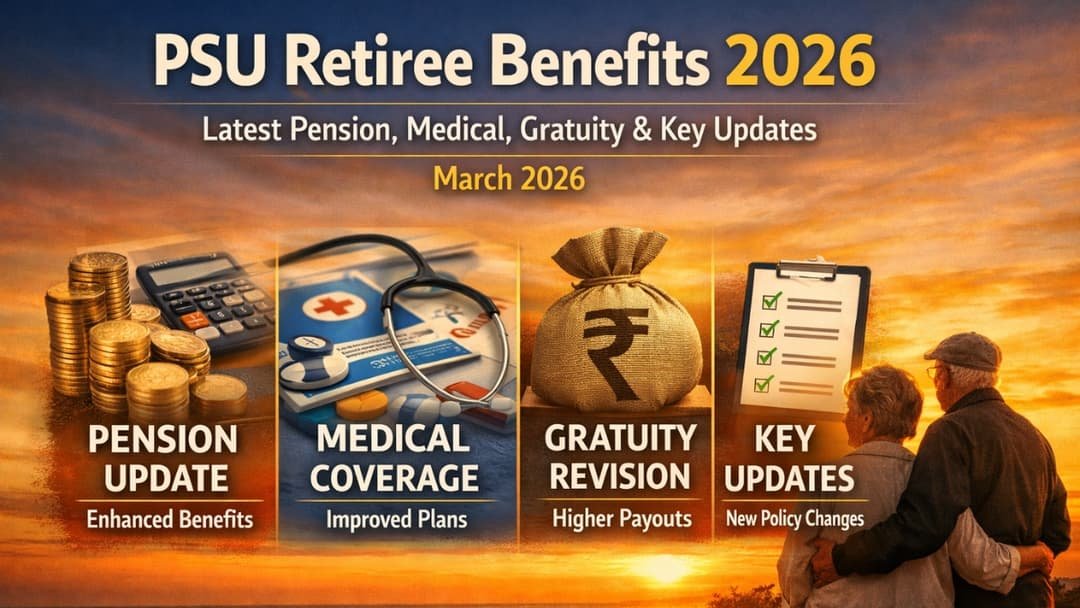

New Delhi : Retired employees from India’s Central Public Sector Enterprises (CPSEs), commonly known as Public Sector Undertakings (PSUs), continue to receive a range of post-retirement benefits in 2026, including pension, medical coverage, gratuity, provident fund savings, and dearness relief. However, the structure of these benefits varies significantly depending on the retirement scheme, the period of employment, and the policies followed by individual enterprises.
Most CPSEs follow guidelines issued by the Department of Public Enterprises (DPE) and broader government rules. Unlike central government pensioners, PSU retirees do not automatically receive revisions under pay commissions, meaning pension adjustments often depend on sector-specific policies or schemes such as the Employees’ Pension Scheme 1995 (EPS-95).
Below is a detailed overview of the latest status of PSU retiree benefits as of March 2026, based on information from government notifications, the Employees’ Provident Fund Organisation (EPFO), and policy updates.
Pension System for PSU Retirees
EPS-95 Pension
The Employees’ Pension Scheme 1995 (EPS-95) remains the primary pension framework for many PSU employees who joined before the introduction of the National Pension System.
- Minimum monthly pension: ₹1,000
- No increase approved yet, despite continued demands from pensioners for an increase to between ₹3,000 and ₹7,500.
- Government responses in Parliament have indicated that while social security through EPFO remains a priority, no immediate pension hike has been approved.
Higher Pension Option
Recent policy discussions within the Employees’ Provident Fund Organisation led to changes in pension contribution rules.
The proposed EPS-2026 regulatory changes removed the clause that allowed higher pension contributions above the ₹15,000 wage ceiling, calling it “obsolete.” However, pension adjustments linked to the 2022 Supreme Court ruling on higher pension eligibility continue to apply in limited cases where employees had already exercised that option.
IDA-Linked Pension
Several CPSEs also follow Industrial Dearness Allowance (IDA)-linked pension structures, similar to older government pay models. In such cases:
- Pension revisions depend on wage settlements and sector-specific decisions.
- Family pension is generally fixed at about 30% of the last drawn salary in many revised pension structures.
National Pension System (NPS)
Employees who joined PSUs after the adoption of the National Pension System receive market-linked retirement benefits under the National Pension System (NPS).
In several public financial institutions and government-linked organizations, employer contributions have increased to up to 14% of basic pay, following policy approvals implemented in recent years.
Dearness Relief
Dearness Relief (DR) continues to be revised twice a year, similar to cost-of-living adjustments for central government pensioners.
- The DR rate for many PSU retirees is currently above 50% of the basic pension.
- Future revisions are generally aligned with inflation trends and central government announcements.
Medical Benefits
Healthcare support remains one of the strongest areas of post-retirement benefits for PSU employees.
Many retirees receive lifetime medical coverage through company health schemes or government programs such as the Central Government Health Scheme (CGHS).
Typical benefits include:
- Cashless hospitalization
- Outpatient treatment reimbursement
- Coverage for dependent family members
- Annual medical check-ups
- Digital claim submission systems introduced in recent years
Large PSUs in sectors such as energy, steel, and oil often maintain comprehensive company-run medical schemes for retirees.
Gratuity Benefits
Gratuity remains a significant retirement benefit for PSU employees under the Payment of Gratuity Act, 1972.
As of 2026:
- Maximum gratuity limit: ₹20 lakh
- Eligibility after minimum five years of service
- Calculation typically equals 15–16.5 times the last drawn salary
While there were discussions in some circles about raising the ceiling to ₹25 lakh, the Department of Public Enterprises clarified in consolidated guidelines issued in January 2026 that the ₹20 lakh cap remains the standard limit for CPSEs.
Additional provisions include:
- Death gratuity for employees who pass away during service
- Service gratuity for eligible early retirements
Provident Fund and Lump-Sum Benefits
At retirement, PSU employees may receive several lump-sum financial benefits:
- Employees’ Provident Fund (EPF) savings with accumulated interest
- Leave encashment for unused earned leave
- Pension commutation, allowing retirees to convert up to 40% of pension into a lump sum
These payments often form a significant portion of retirement income.
Digital Compliance and Life Certificate
Retirees must submit an annual life certificate to continue receiving pension payments. Many have shifted to digital verification through Jeevan Pramaan, a biometric life-certificate system introduced by the government.
This platform allows pensioners to submit certificates online through biometric devices or mobile applications.
Sector-Specific Wage and Pension Revisions
Some government-owned financial institutions and insurance companies have recently implemented revised pay structures.
For example, wage settlements approved for certain public sector insurers and financial institutions include:
- 12.41% increase in wage bill
- 14% employer contribution to NPS
- 30% family pension structure
These revisions apply with effect from 2022, with arrears being implemented in phases.
Policy Developments in 2026
Eighth Pay Commission
The Government of India constituted the Eighth Central Pay Commission in late 2025, with implementation expected from January 1, 2026.
The commission primarily focuses on central government employees and pensioners. PSU retirees do not automatically receive pay commission benefits, though trade unions have demanded similar pension revisions.
Labor organizations such as All India Trade Union Congress (AITUC) have proposed:
- A fitment factor of 3.0 for salary revisions
- Restoration of the Old Pension Scheme (OPS) in some sectors
Consultations for the pay commission were open until mid-March 2026.
Retirement Age
Most CPSE employees retire at 60 years of age, though certain technical or executive roles may have slightly different retirement limits ranging between 58 and 62 years, depending on company policy.
Pension Rule Amendments
Amendments to government pension rules implemented in 2025 introduced stricter provisions regarding pension forfeiture in cases involving misconduct after absorption into PSU service.
However, these rules do not affect genuine retirees who leave service normally.
Key Concern: Minimum Pension Stagnation
Despite multiple demands from pensioners’ organizations, the minimum EPS-95 pension remains ₹1,000 per month. Advocacy groups have organized demonstrations seeking a revision to ₹7,500 plus dearness relief, but the government has not announced any change so far.
Outlook
As of March 2026, PSU retirees continue to benefit from strong medical coverage, gratuity payments, and provident fund savings. However, concerns remain regarding pension adequacy, especially under EPS-95.
Future developments—including recommendations from the Eighth Central Pay Commission and ongoing pension reform discussions—could influence the structure of retirement benefits in the coming years.
Disclaimer: This report is based on official policy information, government notifications, and institutional sources available as of March 2026. Retirement benefits vary across PSUs and individual service conditions. Retirees should verify details through official portals such as the Employees’ Provident Fund Organisation or the Department of Public Enterprises before making financial decisions.