

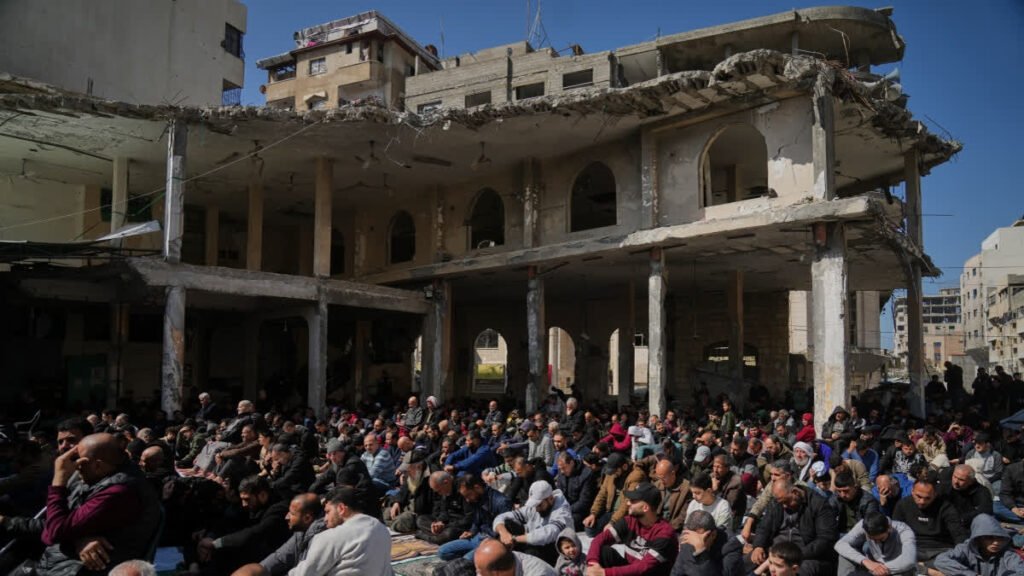
Gaza City / Washington:
The Palestinian militant group Hamas said on Thursday that any discussions on Gaza’s future must begin with a complete halt to Israeli “aggression,” as U.S. President Donald Trump’s newly formed Board of Peace held its first meeting to outline plans for the territory’s reconstruction.
Hamas said arrangements for Gaza must also include the lifting of Israel’s blockade and guarantees of what it described as Palestinians’ legitimate rights, “especially the right to freedom and self-determination.”
The comments came as Trump’s board convened in Washington, D.C. on Thursday, more than four months into a fragile ceasefire between Israel and Hamas. The meeting focused on Gaza’s post-war governance and reconstruction but offered no clear timeline for Hamas to disarm or for Israeli forces to withdraw from the devastated enclave.
International Stabilization Force Proposed
During the meeting, officials announced that several countries — Albania, Indonesia, Kazakhstan, Kosovo, and Morocco — had pledged troops to a proposed International Stabilization Force (ISF) for Gaza. The force is envisioned to include up to 20,000 soldiers along with a new police unit, with Indonesia indicating readiness to contribute as many as 8,000 troops.
Hamas spokesperson Hazem Qassem said the group was open to the presence of international forces under specific conditions. “We want peacekeeping forces that monitor the ceasefire and ensure its implementation, without interfering in Gaza’s internal affairs,” he told AFP.
Ceasefire and Disarmament Dispute
The Board of Peace was formed after the Trump administration, along with longtime mediators Qatar and Egypt, helped broker a ceasefire in October following nearly two years of war.
Under the proposed next phase, Hamas would be required to disarm, Israeli forces would gradually withdraw, and a Palestinian technocratic committee would oversee Gaza’s day-to-day administration. Israeli Prime Minister Benjamin Netanyahu has insisted that Hamas must disarm before any reconstruction begins — a condition the group has repeatedly rejected.
Both Israel and Hamas have accused each other of violating the ceasefire.
Funding Pledges and Mixed Reactions
Trump said countries, primarily from the Gulf region, had pledged more than $7 billion toward Gaza’s reconstruction. Reactions among Palestinians on the ground were mixed.
Some expressed cautious hope that the initiative could bring stability, while others voiced suspicion, fearing the plan could entrench Israeli control rather than lead to genuine self-rule.
International Criticism
Several analysts and diplomats have expressed skepticism about the Board of Peace, warning that it may sideline the United Nations and exclude Palestinian representation.
Hugh Lovatt, a senior fellow at the European Council on Foreign Relations, described the emerging plan as “seriously disturbing,” arguing that it resembled a “colonial project” driven by foreign economic and security interests.
French Foreign Minister Jean-Noël Barrot criticized the participation of the European Commission, saying it lacked a mandate to represent member states. Former U.S. ambassador to Israel Dan Shapiro also questioned the initiative, citing the absence of Palestinian voices and the reliance on Hamas’s disarmament as a precondition for rebuilding.
As diplomatic efforts continue, the future of Gaza remains uncertain, with deep divisions over security, governance, and the path to lasting peace.