

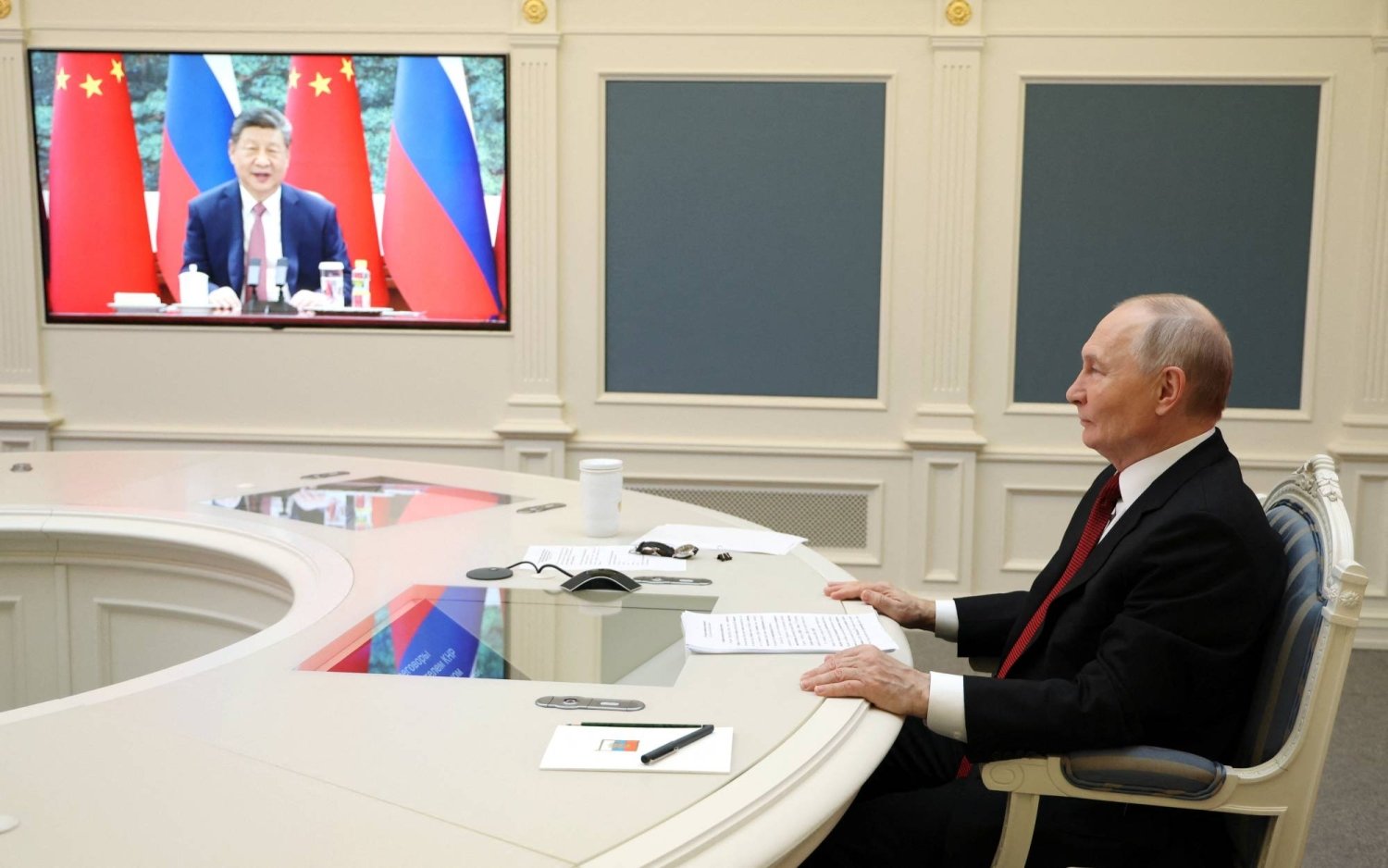

Western officials say China significantly increased its support for Russia’s war in Ukraine during 2025 and is expected to deepen cooperation with Moscow this year, raising doubts about recent European efforts to improve relations with Beijing.
According to officials familiar with the assessments, Chinese backing—particularly through exports of dual-use technology and critical minerals—has become essential to sustaining Russia’s military campaign. They described Beijing as a central enabler of the war, saying the conflict could not continue at its current scale without Chinese assistance.
Xi Jinping has grown more confident and assertive in supporting Vladimir Putin, the officials said. Over the past year, European attempts to persuade China to help bring an end to the war have become increasingly difficult.
Speaking at the Munich Security Conference, Matthew Whitaker said China has the leverage to stop the war if it chooses to do so.
“China could call Vladimir Putin and end this war tomorrow,” Whitaker said. “This war is being completely enabled by China.”
The private assessments contrast with the more cautious public tone adopted by many Western leaders on China’s role in the conflict.
Addressing the conference, Chinese Foreign Minister Wang Yi reiterated Beijing’s position that China is not directly involved in the war and does not control the outcome of any political settlement. He said China continues to support peace talks and diplomacy.
“China will, in our own way, give full support to the peace process,” Wang said.
During a meeting with Wang, German Chancellor Friedrich Merz reportedly urged China to use its influence over Russia to push for an end to the conflict. German Defense Minister Boris Pistorius was more direct, accusing China of supporting Russia’s revisionist agenda.
“Moscow is not acting alone,” Pistorius said. “It is cooperating with China, Iran, and North Korea while trying to turn forums such as BRICS into anti-Western blocs.”
Wang also met Ukrainian Foreign Minister Andrii Sybiha, telling him that China’s leadership actively supports peace negotiations, according to China’s state-run media.
Western officials said Beijing now views the war as strategically beneficial, arguing that it diverts Europe’s focus away from Asia and contributes to strains in transatlantic relations.
Trade between China and Russia has surged since the start of the war, reaching $253 billion in 2024, up from $152 billion in 2021. China has played a key role in helping Russia offset the impact of Western sanctions by purchasing Russian energy and supplying goods that can be used for both civilian and military purposes.
Despite lingering mistrust rooted in their Cold War history, Western officials believe China and Russia currently see more advantages in cooperation than in rivalry.
European leaders continue to argue that engagement with Beijing is necessary to influence its position on global security, even as concerns grow over China’s expanding role in supporting Russia’s war effort.