

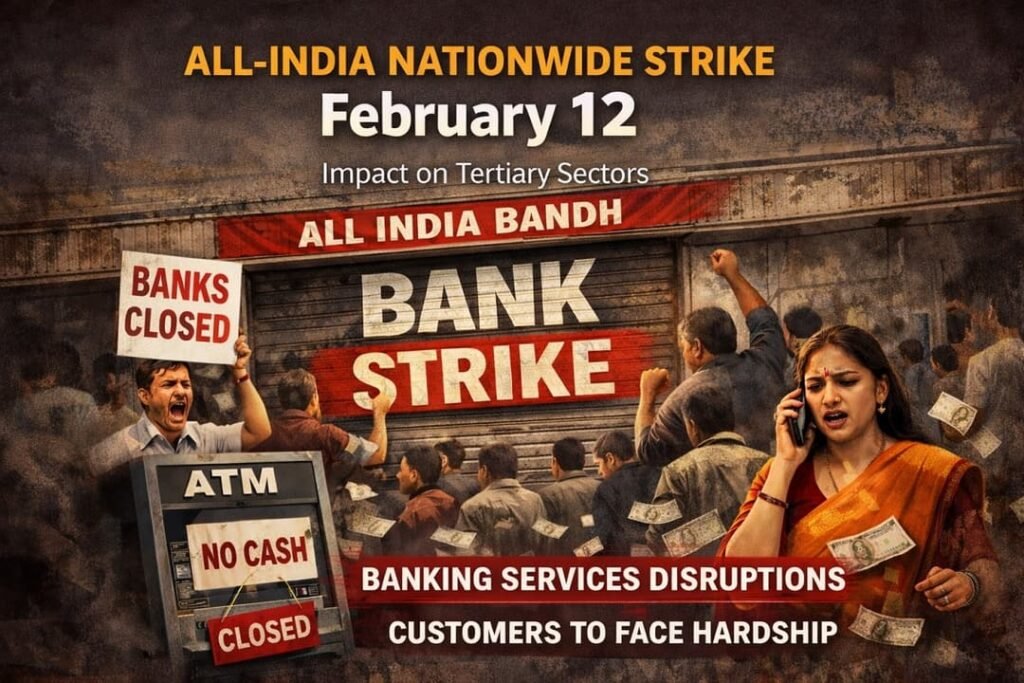
New Delhi: A nationwide strike scheduled for February 12, 2026, is expected to cause widespread disruptions across India’s tertiary sector, particularly impacting banking, financial services, transport, and government offices. The strike—popularly referred to as Bharat Bandh—has been called by a joint forum of 10 central trade unions, with strong backing from farmers’ organizations.
The participating unions include INTUC, AITUC, HMS, CITU, AIUTUC, TUCC, SEWA, AICCTU, LPF, and UTUC. They are protesting against the implementation of the four new labour codes, which aim to replace 29 existing labour laws, along with several other policy proposals.
Banking Services to Be Hit
Public Sector Banks (PSBs), including the State Bank of India (SBI), have warned customers that banking operations may be affected due to employee participation in the strike. Banking unions such as the All India Bank Employees Association (AIBEA), AIBOA, and BEFI have urged their members to take part in the protest.
As a result, customers may face delays or disruptions in:
- Branch-based services
- Cheque clearances
- Cash deposits and withdrawals
- Loan processing and customer support
While online banking and ATM services are expected to function, intermittent disruptions cannot be ruled out.
Importantly, neither the Reserve Bank of India (RBI) nor the central government has declared February 12 as a bank holiday. This means bank branches are officially scheduled to remain open, though services may be limited.
Schools, Transport, and Government Offices
Apart from banks, the strike could affect public transport, government offices, and educational institutions, especially in protest-prone states such as Kerala, Karnataka, and Odisha. In these regions, schools and colleges may remain closed if transport services are disrupted.
Why Are Unions Protesting?
Trade unions argue that the new labour codes weaken job security, reduce workers’ rights, and grant employers greater power to hire and fire employees. They have also raised concerns about:
- Privatization of public assets
- Wage protections
- Lack of social security for workers
Key Demands of the Strike
The unions and farmers’ groups are demanding:
- Repeal of the four labour codes
- Withdrawal of the Draft Seed Bill
- Scrapping of the Electricity Amendment Bill
- Reconsideration of the SHANTI Act (Sustainable Harnessing and Advancement of Nuclear Energy for Transforming India)
- Restoration of MGNREGA in its earlier form and rollback of the Viksit Bharat–Guarantee for Rozgar and Ajeevika Mission (Gramin) Act, 2025
The strike also reflects opposition to the proposed India–U.S. trade deal, which unions fear could adversely affect domestic employment and public sector enterprises.
What Customers Should Do
Banks have advised customers to:
- Complete urgent transactions in advance
- Rely on digital banking where possible
- Expect delays in branch-related services
With multiple sectors likely to be affected, the February 12 Bharat Bandh could significantly disrupt routine economic activity across several states.