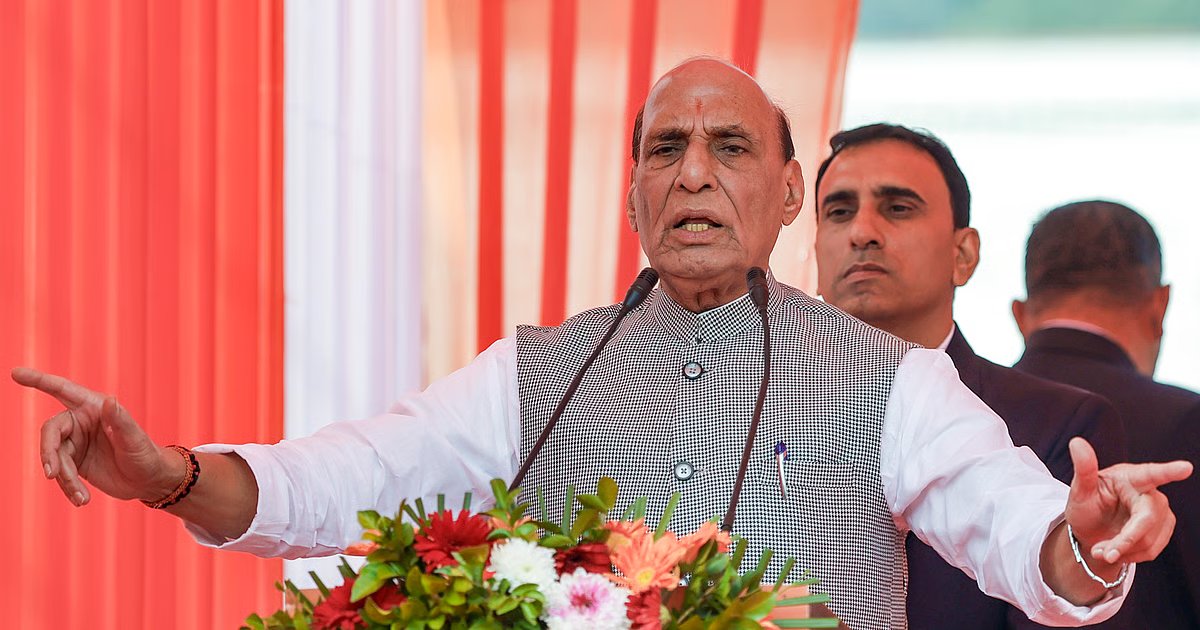

Defence Minister Rajnath Singh on Sunday urged graduating National Defence Academy (NDA) cadets to prepare India for a future where changing demographics will demand greater reliance on machine power and technology than manpower.
Rajnath Singh calls for greater reliance on technology
Addressing the gathering after reviewing the Passing Out Parade of the 151st course in Khadakwasla, Singh said India was a young nation today and would remain so for some time, but its population growth rate was continuously declining.
“Developed nations have already adapted to this change by reducing their reliance on manpower, increasing machine power and technology. We must also prepare in the same direction,” he said.
The minister noted that in the coming decades, India’s youthfulness will begin to decline, so before that happens, the country must develop its capabilities so that changing demographics never become an obstacle to its progress.
Congratulating the cadets on successfully completing their training, he said today marked the beginning of a new journey in their lives.
“Today’s day is a testament to your hard work, perseverance and your unwavering resolve to join the Indian Armed Forces,” he said.
Singh said the uniform carried a massive responsibility.
“Tomorrow, some of you will serve as Lieutenants, Sub-Lieutenants and Flying Officers, while others will serve as Chief Engineers, Chief Artificers, Chief Naval Staff and Chief Air Staff,” he said.
Cadets urged to uphold legacy of armed forces
He reminded the cadets that they were inheritors of a great legacy built by valiant warriors, recalling freedom fighter Jatindra Nath Das, who undertook a 63-day hunger strike for the dignity of the nation, and post-Independence heroes such as Major Somnath Sharma, CQMH Abdul Hamid and Captain Vikram Batra.
“We must always remember why we work and what the purpose of our work is. We must preserve that heritage for which those great revolutionaries sacrificed everything,” Singh said.
“When you go out to the nation’s borders, remember that every soldier who has attained martyrdom is a debt upon us. We are the guardians of the dreams of our freedom fighters,” he added.
Noting that the nature of war had changed, Singh said war was no longer limited to land, sea and air, but was now being fought in new domains such as cyber, space and artificial intelligence.
“Power axes are shifting, global geopolitics is changing, technology is evolving, warfare tactics are transforming, and the very nature of war has evolved,” he said.
India’s training methodology was also evolving, which was essential because technology useful today might become obsolete tomorrow, he said.
“As future military leaders, your goal is to promote a culture of innovation where we can find solutions to our security challenges ourselves,” Singh told the graduating cadets.
He called upon the cadets to become a combination of brain power and manpower that would take India to the forefront of the world.
Singh stresses leadership, teamwork and mental strength
“A good leader is one whom their subordinates can trust unconditionally. You must treat your subordinates with the same care you would your own family,” Singh said.
“When you face difficult situations on the front lines, you must stand by your team. That is the essence of command,” he said.
Recalling his interactions with soldiers at Siachen, on naval ships at sea and during disaster relief operations, Singh said they always displayed exceptional professionalism without fuss, with immense dignity and courage.
“Leave your ego behind and focus entirely on teamwork,” he told the cadets.
While physical fitness and tactical skills were important, Singh said mental strength was equally vital in military life.
“There will be times when circumstances are not in your favour, when you are away from your family, or when you are facing immense pressure. At such times, your courage, self-belief, and mental balance will be your greatest strength,” he said.
He said behind the cadets’ success lay the sacrifice of their parents, the blessings of their elders and the guidance of their teachers.
“Together, we can and will make India strong, self-reliant and secure by 2047,” Singh said.