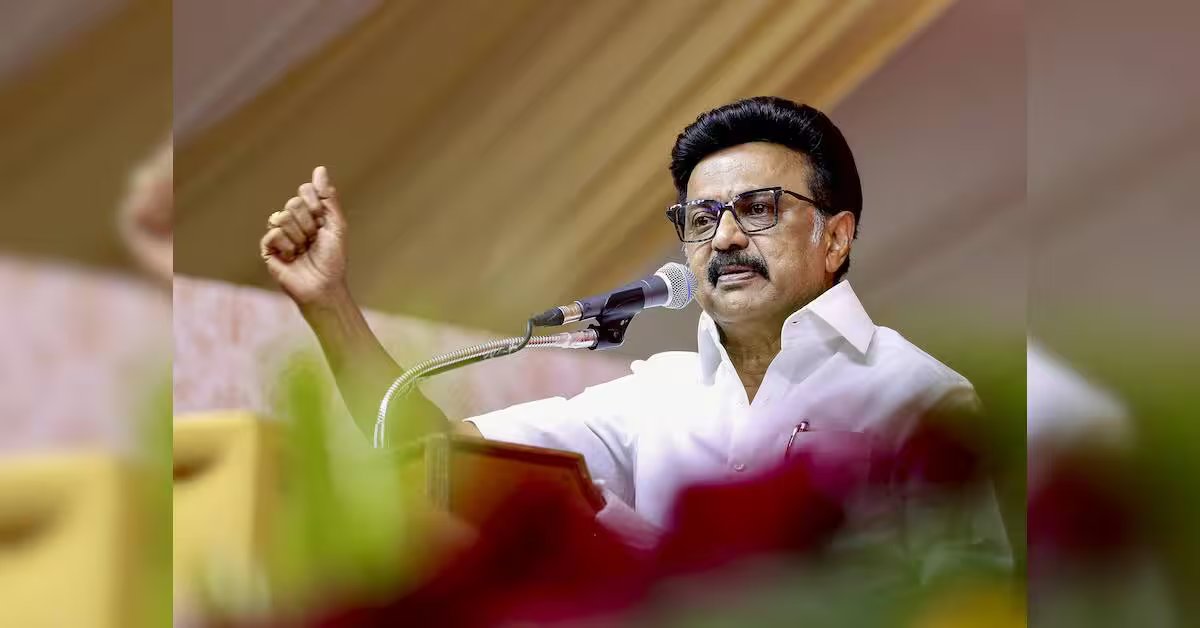

Former Tamil Nadu chief minister and Dravida Munnetra Kazhagam (DKM) supremo MK Stalin on Friday maintained that the state’s existing 7.18 per cent share of Lok Sabha seats must not be reduced under any circumstances if the number of parliamentary constituencies is increased through delimitation. He also demanded that the existing proportion of parliamentary representation among states, based on the 1971 Census, remain unchanged for another 25 years.
His comments came ahead of a special sitting of Parliament, which the government has convened from November 30 to December 3 to transact “essential government business”.
In a post on X, Stalin said the DMK would not compromise on the two demands, which were part of resolutions passed by the Tamil Nadu Legislative Assembly and the Joint Action Committee on fair delimitation.
“If the number of parliamentary constituencies is increased, under no circumstances should Tamil Nadu’s existing 7.18 per cent share of seats in the lower house be reduced,” Stalin said.
He added that the existing proportion of parliamentary representation among states, determined on the basis of the 1971 Census and frozen earlier, must remain unchanged for another 25 years.
“The DMK stands firm on these two demands and will continue to do so. There is no change in our position, and there is no question of any compromise,” he said.
Stalin also said the DMK was the first party in the country to raise concerns about the possible consequences of delimitation. He said Chennai hosted the first meeting that brought together national political leaders to demand a fair delimitation exercise.
Centre plans special Parliament sitting
The Lok Sabha will reconvene on November 30, while the Rajya Sabha will meet on December 2. The sittings will conclude on December 3, subject to the requirements of government business, according to official sources.
Parliamentary Affairs Minister Kiren Rijiju announced the decision on X on Thursday. The special sitting will be an extension of the Monsoon Session, which was adjourned sine die on August 13 but was not formally prorogued.
The Union Cabinet is also expected to discuss the delimitation-linked women’s reservation proposal ahead of the special sitting, news agency PTI reported.
The development has renewed speculation about the government’s plans to reintroduce the Constitution (131st Amendment) Bill, 2026, which was defeated in Parliament in April.
What does the proposed Delimitation Bill seek to change?
The proposed Constitution amendment seeks to increase the maximum strength of the Lok Sabha from the existing 550 to 850 members. This would include up to 815 members from states and 35 from Union Territories, according to the provisions outlined in the proposed legislation.
The Bill also seeks to change the framework governing the allocation of parliamentary seats among states and Union Territories, allowing Parliament to determine which Census figures will be used for delimitation.
The separate Delimitation Bill, 2026, provides for the constitution of a Delimitation Commission to readjust and reallocate seats in the Lok Sabha and state legislative assemblies.
It proposes using the latest published Census figures available when the commission is constituted. This could mean that the next delimitation exercise will use the 2011 Census, the latest published Census data currently available.
The proposed constitutional amendment also seeks to bring forward the implementation of 33 per cent reservation for women in the Lok Sabha and state legislative assemblies.
Under the Constitution (106th Amendment) Act, 2023, women’s reservation was linked to the completion of a Census followed by delimitation. The proposed amendment seeks to remove the requirement of waiting for a fresh Census and enable the quota to take effect following delimitation based on the latest published Census figures.
The government aims to implement the reservation ahead of the 2029 Lok Sabha elections.
Previous attempt to pass the Bill failed
The government had introduced the Constitution (131st Amendment) Bill, 2026, alongside the Delimitation Bill, 2026, and the Union Territories Laws (Amendment) Bill during a special sitting of Parliament in April.
However, the Constitution amendment failed to secure the required two-thirds majority in the Lok Sabha on April 17. Of the 528 members who voted, 298 supported the Bill and 230 opposed it. The proposal fell short of the required 352 votes.
The defeat rendered the two related Bills infructuous, and they were not taken up for consideration.