
Naina (name changed), a lifelong Bollywood fan, always dreamed of a wedding straight out of a Karan Johar film—a grand venue, extended families in attendance, and a Manish Malhotra lehenga. But when she started planning her big day, the very first step came with a price tag that left her shocked.
“Among all the wedding-related expenses, venue bookings have turned out to be the most expensive, costing much more than I had expected or budgeted for,” said the 30-year-old who is getting married this month.
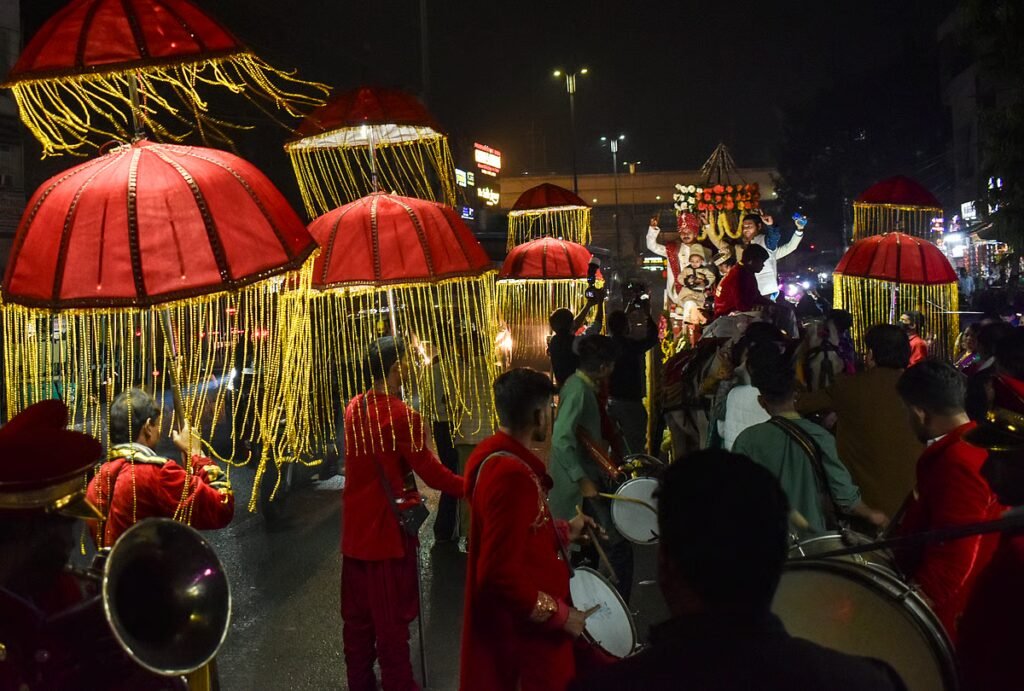
Naina’s experience is not unique. As the wedding season begins, many families are revising their budgets as the cost of venue, food, clothes and other arrangements continues to rise.
India’s wedding season is expected to generate business worth ₹7.5 trillion from an estimated 5.2 million weddings between November 21 and December 15, 2026, according to the Confederation of All India Traders (CAIT). Goods and retail purchases are projected to account for ₹4.05 trillion, or 54 per cent of the estimated business, while services are expected to contribute the remaining ₹3.45 trillion.
However, the celebrations are coming at a time when household budgets are already under pressure. Retail inflation rose to 6.09 per cent in October, crossing the Reserve Bank of India’s (RBI’s) upper tolerance limit of 6 per cent for the first time in two years. Higher food prices were a major reason for the increase.
Food and venue costs push up wedding bills
Food is among the biggest expenses at an Indian wedding, particularly when families host large gatherings. Rising prices of everyday ingredients are pushing up catering bills.
Food retail inflation, measured by the Consumer Food Price Index (CFPI), touched a 23-month high of 8.94 per cent in October. Onions, garlic, ginger and lemons saw some of the sharpest price increases. Other ingredients used in wedding sweets and savouries, including ghee, milk, butter and curd, have also become costlier.
Sanjay Kumar, a wedding venue owner in Muzaffarnagar, Uttar Pradesh, told Business Standard that higher costs of dry fruits, sugar, ghee and labour have raised per-plate catering costs in the area by nearly 25-30 per cent.
Shivani Pandey (name changed), 28, who is getting married in March next year, said the per-plate cost at her chosen venue on the Gurugram-Delhi Expressway has increased from ₹3,100 at the time of booking to ₹3,575 now.
“That is a considerable jump, especially when you consider the number of guests we are expecting,” Shivani said.
According to IMARC’s November report, India Wedding Services Market Size, Share, Trends & Forecast (2026–2034), higher costs for venues, catering and decoration are making weddings harder to afford for lower- and middle-income families, limiting market growth despite strong demand.
A Delhi-based wedding caterer told Business Standard that lower- and middle-income families are cutting guest lists and increasingly choosing venues outside Delhi and other big cities. “Venues in places such as Rishikesh and areas in Himachal Pradesh are much more affordable. For instance, a farmhouse in Delhi that would cost ₹6 lakh to book can be booked for around ₹60,000 in Rishikesh and other places outside major cities,” the caterer said.
Families are also reducing spending on catering, vendors and decoration. Guest lists, traditionally a defining feature of Indian weddings, have almost halved, according to Kumar said.
“Weddings that earlier had around 1,000 guests are now being scaled down to 500, while gatherings of 500 guests have shrunk to around 250,” said Kumar. Those looking to host smaller weddings are increasingly opting for dharamshalas or smaller banquet halls, he added.
With gold being an important part of wedding purchases, families are looking to cut costs on other expenses, including vendors, catering and decoration. This is also reflected in venue bookings, Kumar said.
“Earlier, families would book halls for two to three days to accommodate different wedding functions. Now, they are increasingly limiting bookings to just one day,” he said.
For some families, managing these expenses means making the difficult choice about who to leave out of the guest list.
“We have decided to trim the guest list to keep the expenses under control. My father is a retired bank executive, and we have had to remove a few of his former colleagues from the guest list, as well as a few of our distant family friends. These are the kinds of adjustments we had to make to manage the rising costs,” said Shivani.
Wedding wardrobe gets a rethink
For many brides, the lehenga is one of the most personal parts of wedding shopping—and often one of the most expensive. Markets such as Delhi’s Chandni Chowk and Lucknow’s Aminabad draw brides looking for the right fit, designer-inspired styles and the latest social-media trends. But what is changing, shopkeepers say, is how much families are willing to spend across the wedding functions.
“Wedding budgets have come down, and demand for mid-range lehengas has increased. Demand for premium lehengas has also declined,” Kamal Bhai, who owns a bridal lehenga shop in Chandni Chowk, told Business Standard.
The shift comes as rising production and input costs across India’s textile and ethnic wear industry push up retail prices. The impact of the West Asia war on raw material costs was felt across Surat’s textile value chains, with thread, zari, embroidery and processing businesses passing on higher input costs to buyers.
“Earlier, brides would buy heavy outfits for all their wedding functions, but now they are purchasing one heavy outfit for the wedding and opting for lighter ones for the other functions,” Kamal said. “The impact is mainly visible among middle- and lower-middle-income customers.”
For shoppers, the price jump is not tangible. “The lehenga that I purchased back in June-July is now costing double,” said Naina. “A lehenga that earlier cost ₹30,000-40,000 is now priced at ₹70,000-80,000.”
Jewellery purchases become more selective
While jewellery remains one of the biggest expenses for Indian weddings, rising costs are making families more selective about the purchase.
Gold prices have fluctuated sharply in 2026, rising to record highs before correcting in recent months. 24-carat gold rose from around ₹1.35 lakh per 10 grams on January 1 to a peak of ₹1.79 lakh on January 30, before falling to around ₹1.28 lakh on November 20. The 22-carat rate declined from its January peak of ₹1.64 lakh to around ₹1.17 lakh.
The World Gold Council (WGC) said domestic gold prices were down 4 per cent year-to-date as of November 12, while international prices had fallen 11 per cent in US dollar terms. However, festive-season prices were nearly 10 per cent higher than a year ago, while year-on-year prices were up 17 per cent, according to its November 17 India market update.
According to Om Pal Singh, who runs a jewellery store in Sector 90, Gurugram, there is not a major change in overall spending by customers during the wedding season. However, buyers are cutting down on the number of jewellery pieces they buy.
“They are still purchasing essential gold jewellery, particularly pieces that they consider important for the bride to wear on her wedding day. But they are avoiding some of the additional purchases,” he said.
For example, some families that prefer the bride to wear original gold jewellery are now choosing to buy only a gold necklace and earrings set, while dropping purchases such as a maang tikka, said Om Pal.
“Instead, they are opting for an artificial maang tikka, which costs less,” he said, adding that customers are also preferring lighter jewellery instead of heavier sets.
Not everyone is feeling inflation pangs
Inflation doesn’t affect every wedding equally, and neither does the response to it.
Neha Seth Arora, co-founder of Mumbai-based wedding planning firm Saffron String LLP, said inflation affects different segments of the market differently.
“For a family working within a defined budget, the decisions can be quite practical. Do we host 500 guests or 350? Do we have an elaborate spread across every function, or make the main wedding meal the highlight?” she said.
At the ultra-luxury end, Arora said the priorities can be quite different. “Families may be clear about the scale, design and level of hospitality they want to deliver, and those expectations don’t necessarily change with rising costs. Instead, the focus may be on sourcing, production efficiencies and ensuring that the investment goes into the elements that have the greatest impact on the overall experience,” she said.
Nilanjan Banik, professor of economics and finance at Mahindra University, told Business Standard that rising inflation is likely to make India’s upcoming wedding season more expensive, but is not expected to stop large celebrations outright.
“Inflation raises both the direct cost of wedding inputs and the premium charged on auspicious ‘muhurat’ dates. Caterers, photographers, and makeup artists may charge 1.2-1.5 times their normal rates during peak periods, while food and venue costs are estimated to rise 6-11 per cent annually,” he said.
Keep the vows, trim the frills
Mukta Kapoor, director of Yuna Weddings & Events, said while rising costs certainly puts pressure on wedding budgets, Indian weddings are deeply personal celebrations and families are generally reluctant to compromise on what they have envisioned.
“Clients are asking more questions, weighing their options and being more conscious of where their money is going. They still want a beautiful wedding, but they also want to know that what they are spending is worthwhile,” said Kapoor.
For Shivani, her family had to rethink a few things considering the rising costs. “But we have tried to keep the arrangements as close as possible to what we had originally planned,” she said.