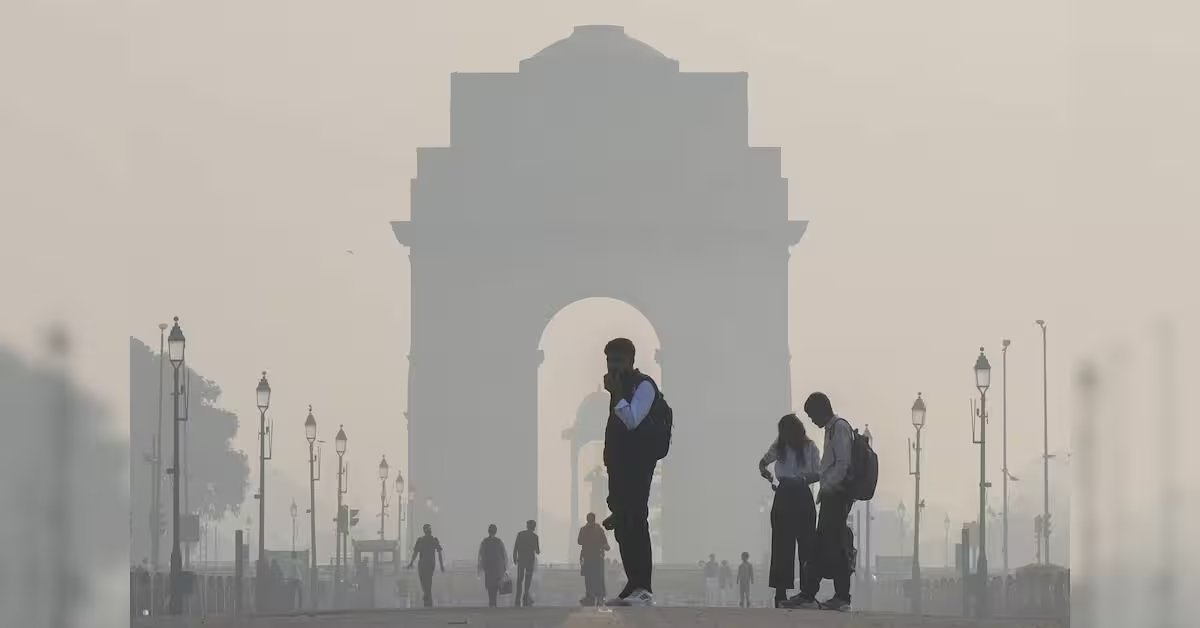

Delhi’s air quality remained in the ‘very poor’ category a week after Diwali, with experts attributing the prolonged pollution crisis to inadequate year-round emission controls that allowed the city’s pollution baseline to rise to a three-year high even before the festivities. Unchecked firecracker use and farm fires further worsened Delhi’s already high pollution levels, which are yet to subside.
Delhi recorded a city-level Air Quality Index (AQI) of 351 at 8 am on Sunday, in the ‘very poor’ category. Several monitoring stations registered ‘severe’ readings, with IIT Delhi recording the highest AQI of 426. About 62 per cent of the city’s pollution on Sunday came from sources outside Delhi, according to data.
An analysis by the Centre for Science and Environment (CSE), released earlier this week, found that average PM2.5 concentrations in the week before Diwali stood at 236 micrograms per cubic metre (µg/m³) — the highest in three years. This was 97 per cent above the 2025 average of 120 µg/m³ and 32 per cent higher than the 2024 level of 179 µg/m³. The pre-festival pollution burden was therefore substantially higher than in previous years.
“When we separate the seasonal baseline from the festival, the picture changes. In the week before Diwali 2026, the PM2.5 was already more than double of last year’s levels,” said Alok Kumar, research scientist at IIT Delhi. “In November, cooler nights, weak winds and a shallow mixing layer trap pollution close to the ground. That is why the season, not one night, sets most of what Delhi breathes.”
Diwali nevertheless added to the pollution burden. Climate Trends, a Delhi-based research consultancy, found that the festival increased AQI in all nine cities covered in its analysis over the past three Diwali cycles (2024-26), with rises ranging from 4 per cent to 139 per cent compared with the preceding week. The relative increase was the greatest in cities with cleaner pre-festival air.
“Delhi’s jump was small in relative terms in 2024 (+13 per cent) and 2026 (+4 per cent) because the pre-Diwali week was already ‘poor’ to ‘very poor’ (295 in 2024 and 347 in 2026),” the analysis said. But Delhi’s absolute AQI during the Diwali period has risen each year, from 334 in 2024 to 348 in 2025 and 360 in 2026, it added.
Vehicular emissions, rather than farm fires alone, remain a major driver of the city’s pollution, said Anumita Roychowdhury, executive director of research and advocacy at CSE. “Stubble burning contribution over the past week has been varying between 8 per cent and 11 per cent, and went up to 16 per cent one day. But overall, if you look at IITM (Indian Institute of Tropical Meteorology) data and if you consider Delhi’s local sources, then vehicles are at the top,” she told Business Standard.
CSE’s analysis found that smoke from farm fires peaked at a seasonal high of 16.2 per cent on November 4. Yet by November 6, when Stage 3 of the Graded Response Action Plan (GRAP) was invoked, Delhi’s AQI had deteriorated to 382 even as the stubble-burning contribution fell to about 8 per cent. Severe pollution episodes thus persisted despite declining farm-fire emissions, pointing to the role of intense local sources.
Firecracker pollution is harder to capture in source-apportionment estimates because it is episodic, Roychowdhury said. However, its concentrated emissions can substantially worsen overall air quality during short periods. An IITM assessment estimated that firecrackers accounted for about 71 per cent of Delhi’s PM2.5 pollution on Diwali night and 43.4 per cent between 1 am and 9 am on November 8, the day of the festival.
Separately, CSE’s analysis of IITM’s Decision Support System data for November 1-8 found that 54 per cent of Delhi’s PM2.5 pollution originated in neighbouring National Capital Region (NCR) districts, while 33 per cent came from sources within Delhi and 14 per cent from stubble burning. Within the contribution from Delhi’s own sources, vehicular transport accounted for 52 per cent.
Pollution adds to stress on agriculture
The consequences of deteriorating air quality extend beyond human and animal health to plant and crop health, potentially adding another stress factor for Indian agriculture.
Keshav Anand, MD of agrochemical firm Parijat Industries, said the pollution crisis could affect crops during critical growth stages, particularly in the ongoing Rabi season. Wheat, mustard and chickpea warrant close monitoring, he said.
“Ground-level ozone enters plant leaves through stomata, damages leaf tissues and interferes with photosynthesis, while particulate matter such as PM2.5 can settle on leaf surfaces and affect essential plant functions,” Anand said. The risks increase when pollution coincides with moisture stress and fluctuating weather conditions.
Farmers should watch for leaf injury, reduced plant vigour and increased pest or disease incidence, he said. Where secondary pest and disease pressure emerges, need-based application of recommended fungicides and insecticides can help prevent losses.
A problem with no single source
Experts cautioned against treating firecrackers or any other individual source as the sole explanation for Delhi’s pollution crisis.
Firecrackers aggravated already deteriorating air quality by adding a concentrated burst of PM2.5 to an atmosphere carrying a heavy baseline pollution load. But focusing only on seasonal spikes would miss the wider challenge, said S K Dhaka, professor in the Department of Physics at the University of Delhi.
Air pollution is a complex, interconnected problem that cannot be attributed to a single source or tackled through isolated interventions, said Shikha Srivastava, head of Urban Poverty Alleviation at Tata Trusts. “It calls for a holistic, long-term approach that brings together environmental sustainability, urban development and public health.”
Arindam Ghatak, chief executive of health-tech company Biomoneta, said differing assessments of pollution sources often reflect variations in geography, season and measurement methodologies. Vehicular emissions, industrial activity, construction dust, biomass burning and agricultural residue burning all contribute to the problem, he said. Winter meteorological conditions compound their impact by trapping pollutants closer to the ground.