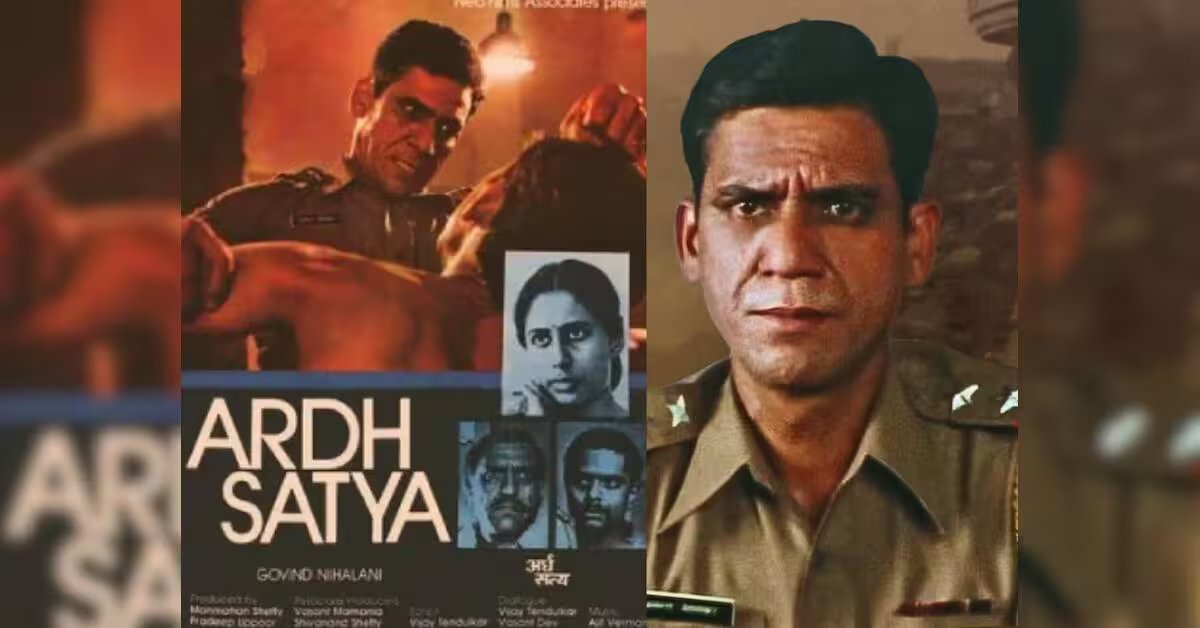

When two young college lecturers, Jyotsna (Smita Patil) and Sneha (Ila Arun), arrive at a mill in Bombay (now Mumbai) to interview striking labourers, they meet the sub-inspector of police, Anant Velankar (Om Puri). Velankar and Jyotsna are acquainted from before, and he is on duty at the factory to prevent any disturbance. He advises the academics to leave the site as trouble is about to break out soon. As they walk away, Sneha asks Jyotsna how she knows Velankar, adding: “Did you see he was drunk?” Looking back, Jyotsna catches a glimpse of Velankar leading a lathi charge on the protesting labourers. A little later in the film, having read and learnt about police brutality, Jytosna, who is now in a relationship with Anant, tells him to leave his job. “My husband will not be a policeman,” she declares.
Produced by the National Film Development Corporation and directed by Govind Nihalani, ‘Ardh Satya’ (1983) is a visceral interrogation of the functioning of the Indian police. Its protagonist, Velankar, is a reluctant officer: He is forced into the police by his father (Amrish Puri), who is a constable. When Jyotsna and Velankar meet for the first time, at a party, early in the film, he tells her that he does not drink. However, as he gets embroiled more and more in the demanding life of a police officer, Velankar takes to drinking. And alcohol releases his frustrations with life in the form of volcanic anger. In his inebriated state, he calls up Jyotsna at times or gets into fights. Towards the end of the film, he brutally assaults a suspect in custody, killing him.
In recent years, however, the moral authority of the police in these films has been challenged. In his autobiography ‘Water in a Broken Pot’ (2023), Yogesh Maitreya writes about how meetings of Dalit Panthers in Bombay in the 1970s were routinely attacked by the police and “in reality, the police were seemingly angry about Dalits who were demanding their rights and seeking justice”. By the 1980s, writes Raghavendra, “the police were shown as weak” in films like ‘Tezaab’, directed by N. Chandra, “because the state was seen to have been weakened by divisive forces”.
Written by Vijay Tendulkar, ‘Ardh Satya’ represents these divisive forces through the nexus of politics and crime through the sinister character of Rama Shetty (Sadashiv Amrapukar). A gangster running illegal gambling dens, Shetty gets repeatedly into confrontations with Velankar. When Velankar arrests his men, Shetty gets them released. When Velankar tries to arrest him on a murder charge, Shetty uses his influence with senior officers to avoid the arrest. Then, Shetty stands for elections to the municipal corporation and becomes an influential politician, and Velankar has to appeal to him for help, when he is suspended for the custodial death.
What makes ‘Ardh Satya’ unsettling even now is not merely depictions of police brutality, but the recognition that violence is embedded in the very structures of power. Velankar’s predicament exposes the contradictions of an institution expected to uphold the law and yet forced to work beyond it. This is embodied in the titular poem, written by Dilip Chitre for this film. Velankar’s final act of violence offers no resolution; it reproduces the structure against which he has struggled. The “half-truth” of the title captures the enduring failure of justice in a society governed by force.
Uttaran Das Gupta is an independent writer and journalist